
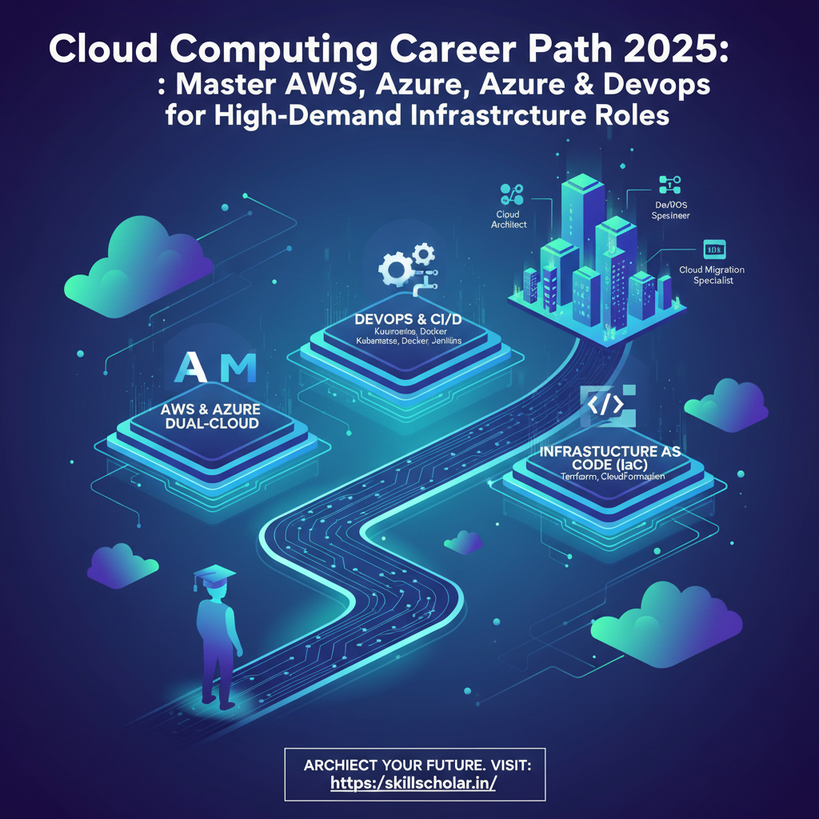
The 2025 Cloud Computing Landscape: Your Gateway to High-Growth Infrastructure Careers
Estimated reading time: 6 minutes
Key Takeaways
- Dual-cloud proficiency in AWS and Azure is now a market imperative, not a specialization.
- Core career pillars for 2025 are Cloud Platform Mastery, DevOps Engineering, and Infrastructure as Code (IaC).
- High-demand roles like Cloud Architect, DevOps Engineer, and Cloud Security Specialist offer significant growth and compensation.
- Structured, hands-on learning and certification are critical for bridging the industry’s talent gap.
Table of Contents
- Why Cloud Infrastructure Roles Are the Hottest Jobs of 2025
- Core Pillar 1: Mastering AWS & Azure – The Dual-Cloud Imperative
- Core Pillar 2: DevOps Engineering – The Engine of Cloud Velocity
- Core Pillar 3: Infrastructure as Code (IaC) – Defining Modern Infrastructure
- Mapping Your Path to Key Cloud Infrastructure Jobs
- The Skill Scholar Advantage: Building Your Personalized Cloud Career Roadmap
- Your First Step on the 2025 Roadmap
The cloud is no longer the future; it’s the foundational present of global business infrastructure. As we move deeper into 2025, the demand for skilled professionals who can architect, secure, and manage cloud environments is accelerating at an unprecedented rate. Companies are not just migrating to the cloud—they are rebuilding their entire digital DNA upon it. This seismic shift has created a talent gap that represents a golden opportunity for those with the right skills. Whether you’re an IT professional looking to pivot, a recent graduate, or a career-changer, mastering platforms like AWS and Azure, coupled with DevOps and Infrastructure as Code (IaC) principles, is your ticket to a resilient, high-paying career. This guide, crafted from the deep industry expertise at Skill Scholar, maps out the definitive career paths, essential certifications, and core competencies you need to thrive in the cloud infrastructure domain.
Why Cloud Infrastructure Roles Are the Hottest Jobs of 2025
The data is unequivocal. The global push for digital transformation, hybrid work models, AI integration, and data-driven decision-making is powered by cloud infrastructure. Roles like Cloud Architect, DevOps Engineer, and Cloud Security Specialist consistently top “best jobs” lists, not just for their compensation—which often exceeds six figures—but for their job security and growth potential. The cloud market’s continuous expansion means these are not fleeting trends but long-term career pillars. For professionals at Skill Scholar, we see this demand firsthand: organizations are seeking individuals who can do more than just manage servers; they need strategists who can optimize costs, ensure ironclad security, and enable rapid, reliable software delivery.
Core Pillar 1: Mastering AWS & Azure – The Dual-Cloud Imperative
Gone are the days of specializing in a single vendor. The modern enterprise landscape is multi-cloud by design, seeking to avoid vendor lock-in and leverage best-in-breed services. Your 2025 career roadmap must include proficiency in both Amazon Web Services (AWS) and Microsoft Azure.
AWS Certification Path for Infrastructure Roles:
Start with the AWS Certified Solutions Architect – Associate. This is the cornerstone, teaching you to design distributed systems on AWS. From there, infrastructure specialists should target the AWS Certified SysOps Administrator – Associate for operations mastery, and then advance to the AWS Certified DevOps Engineer – Professional. This progression validates your ability to automate, monitor, and manage AWS environments at scale—a critical skill for any cloud infrastructure job.
Azure Cloud Skills for the Enterprise:
With Microsoft’s deep integration into corporate IT, Azure expertise is non-negotiable. Begin with the Microsoft Certified: Azure Administrator Associate (AZ-104), which covers managing compute, storage, networking, and security. To design solutions, pursue the Microsoft Certified: Azure Solutions Architect Expert. For those focused on the DevOps pipeline within Azure, the Microsoft Certified: DevOps Engineer Expert certification is the ultimate credential. At Skill Scholar, our curriculum is designed to build this dual-vendor competency, ensuring you’re versatile and highly marketable.
Core Pillar 2: DevOps Engineering – The Engine of Cloud Velocity
Cloud infrastructure exists to deliver applications. DevOps engineering is the discipline that bridges the gap between development and operations, creating a streamlined pipeline for continuous integration and delivery (CI/CD). It’s the practice that makes cloud agility a reality.
Key skills include mastering CI/CD tools like Jenkins, GitLab CI, or GitHub Actions; configuration management with Ansible, Puppet, or Chef; and containerization with Docker and orchestration with Kubernetes. A DevOps certification, such as the Docker Certified Associate (DCA) or the Certified Kubernetes Administrator (CKA), adds significant weight to your resume. The mindset is as important as the tools: fostering collaboration, automating everything, and focusing on measurable outcomes. This is not just a role; it’s a cultural and technical shift that defines modern IT departments.
Core Pillar 3: Infrastructure as Code (IaC) – Defining Modern Infrastructure
Manually clicking in a cloud console is the way of the past. The standard for 2025 is Infrastructure as Code (IaC), where you define and provision cloud resources using machine-readable definition files. This ensures consistency, repeatability, version control, and rapid deployment.
You must become proficient in tools like Terraform (cloud-agnostic) or AWS CloudFormation / Azure Resource Manager (ARM) templates. Writing IaC is akin to writing software for your infrastructure, and it’s a mandatory skill for roles from Cloud Engineer to Cloud Architect. It directly ties into DevOps practices, enabling infrastructure changes to be part of the same automated pipeline as application code.
Mapping Your Path to Key Cloud Infrastructure Jobs
Here’s how these skills converge into specific, high-demand roles:
1. Cloud Architect
The Role: The master planner. You design the overall cloud environment, aligning technology with business needs, focusing on cost, performance, security, and reliability.
Your 2025 Toolkit: Advanced AWS/Azure architect certifications, deep IaC knowledge (Terraform), strong understanding of networking and security frameworks, and excellent communication skills.
2. DevOps Engineer
The Role: The automation champion. You build and maintain the CI/CD pipeline, automate infrastructure provisioning, and ensure smooth, frequent releases.
Your 2025 Toolkit: DevOps certifications, expertise in Kubernetes, Docker, Jenkins, and scripting languages (Python, Bash), and a solid grasp of both development and operational concerns.
3. Cloud Security Specialist
The Role: The guardian. With threats evolving, this role is critical. You implement identity and access management (IAM), encryption, compliance frameworks, and security monitoring.
Your 2025 Toolkit: Certifications like AWS Certified Security – Specialty or Microsoft Certified: Azure Security Engineer Associate, knowledge of tools like Wiz or Palo Alto Prisma Cloud, and a proactive threat-hunting mindset.
4. Cloud Migration Specialist
The Role: The transition expert. You lead the complex process of moving legacy on-premises systems to the cloud, a massive undertaking for thousands of businesses.
Your 2025 Toolkit: Experience with migration tools (AWS Migration Hub, Azure Migrate), deep understanding of legacy systems, project management skills, and a strategy for minimizing downtime and cost.
The Skill Scholar Advantage: Building Your Personalized Cloud Career Roadmap
Navigating this landscape can be overwhelming. That’s where a structured learning path makes the difference. At Skill Scholar, we don’t just provide information; we build career architects. Our approach is centered on:
- Hands-On, Project-Based Learning: Theory is useless without practice. Our modules are built around real-world scenarios where you build and deploy actual cloud environments.
- Dual-Cloud Proficiency: Our curriculum is designed to give you actionable skills in both AWS and Azure, making you adaptable and highly sought after.
- Certification-Focused Preparation: We align our training with the exact objectives of key certifications, providing the knowledge and practice exams to ensure you pass with confidence.
- Community & Mentorship: You learn alongside peers and from industry veterans who provide guidance, code reviews, and career advice.
Your First Step on the 2025 Roadmap
The journey to a high-demand cloud infrastructure role begins with a single, deliberate step. Assess your current skills, choose a starting point (often the foundational AWS or Azure administrator certification), and commit to consistent, hands-on learning. The market demand is clear, the tools are available, and the path is well-defined.
The cloud is the platform upon which the next decade of innovation will be built. By mastering AWS, Azure, DevOps, and IaC, you are not just learning tools; you are building the foundational skillset for a career defined by growth, impact, and opportunity. Let 2025 be the year you architect your future.
Ready to transform your career? Explore Skill Scholar’s structured learning paths and begin building the in-demand cloud expertise that defines the infrastructure leaders of tomorrow.