
“`html
Navigating Your Machine Learning Career Path in 2025
Estimated reading time: 8 minutes
Key Takeaways
- High demand for AI skills continues to grow across all industries, creating lucrative career opportunities
- Solid foundation in programming, math, and data wrangling is essential before advancing to specialized areas
- Deep learning and ML engineering skills are critical for bridging the gap between research and production systems
- Practical portfolio projects and structured learning paths significantly accelerate career progression
Table of Contents
- The 2025 AI Landscape: Why Machine Learning Skills Are in High Demand
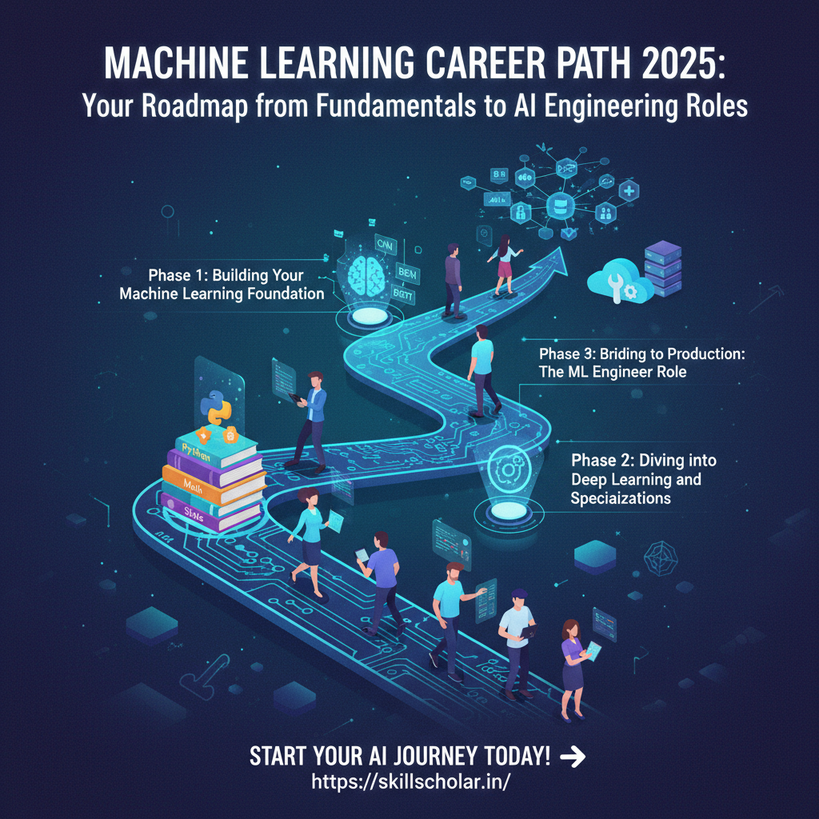
- Phase 1: Building Your Machine Learning Foundation
- Phase 2: Diving into Deep Learning and Specializations
- Phase 3: Bridging to Production: The ML Engineer Role
- Your 2025 Action Plan: From Learning to Earning
- Conclusion: Your Future in AI Starts Now
The 2025 AI Landscape: Why Machine Learning Skills Are in High Demand
Before diving into the “how,” it’s crucial to understand the “why.” The demand for machine learning expertise is being driven by a perfect storm of data availability, computational power, and algorithmic innovation. Companies are leveraging AI for everything from hyper-personalized customer experiences and fraud detection to optimizing supply chains and developing autonomous systems. This widespread adoption has created a significant talent gap, making AI engineering jobs some of the most lucrative and secure positions in the tech market. The ML engineer role is no longer a luxury for tech giants; it’s a necessity for businesses of all sizes aiming to stay competitive.
Phase 1: Building Your Machine Learning Foundation
Every skyscraper needs a deep foundation, and your AI career is no different. Attempting to jump straight into advanced concepts like transformer models or generative adversarial networks (GANs) without a solid base is a recipe for frustration.
Core Technical Prerequisites
Your journey starts with three pillars:
- Programming Proficiency: Python is the undisputed king of the ML world. Fluency in Python, along with key libraries like NumPy and Pandas for data manipulation, is non-negotiable.
- Mathematics & Statistics: You don’t need a math PhD, but a strong conceptual understanding is vital. Focus on Linear Algebra (vectors, matrices), Calculus (gradients, derivatives), and Probability & Statistics (distributions, statistical testing).
- Data Wrangling & Visualization: Real-world data is messy. The ability to acquire, clean, and explore data using tools like Pandas and visualization libraries like Matplotlib or Seaborn is a critical first step in any ML project.
Mastering Foundational ML Concepts
Once the prerequisites are in place, you can tackle core machine learning concepts. This involves understanding the different types of learning:
- Supervised Learning: Mastering algorithms like Linear Regression, Logistic Regression, Decision Trees, and Support Vector Machines (SVMs) for labeled data.
- Unsupervised Learning: Exploring techniques like Clustering (K-Means) and Dimensionality Reduction (PCA) for unlabeled data.
- Model Evaluation: Learning how to properly train, validate, and test models using metrics like accuracy, precision, recall, F1-score, and ROC curves to avoid overfitting.
Phase 2: Diving into Deep Learning and Specializations
After solidifying your fundamentals, you can venture into the powerful world of deep learning. This is where you start to build the sophisticated AI systems that are shaping the modern world.
Essential Deep Learning Skills
Deep learning skills are centered around neural networks. You’ll need to get hands-on with frameworks like TensorFlow or PyTorch. Key concepts include:
- Feedforward Neural Networks
- Convolutional Neural Networks (CNNs)
- Recurrent Neural Networks (RNNs) and LSTMs
- Training dynamics, optimization algorithms (like Adam), and regularization techniques.
Choosing Your AI Specialization
This is where you can tailor your machine learning career path to your interests. The two most prominent and in-demand fields are:
- Computer Vision Career: If you’re fascinated by how machines “see,” this is for you. A career here involves working on image classification, object detection, facial recognition, and autonomous vehicle perception using CNNs and beyond.
- NLP Specialist: Natural Language Processing is the engine behind chatbots, translation services, and sentiment analysis. Becoming an NLP specialist requires deep knowledge of transformers, BERT, GPT architectures, and word embeddings to process and understand human language.
Phase 3: Bridging to Production: The ML Engineer Role
Many aspiring practitioners focus solely on modeling, but the real-world value of AI is realized in production. This is the domain of the Machine Learning Engineer.
The Art of ML Model Deployment
ML model deployment is the process of integrating a trained model into an existing production environment to make practical business decisions. This is a complex engineering challenge that goes beyond writing a Jupyter notebook. It involves:
- Building scalable and reproducible ML pipelines (e.g., with Kubeflow or Airflow).
- Containerizing models using Docker.
- Serving models via APIs (e.g., using TensorFlow Serving or FastAPI).
- Leveraging cloud platforms like AWS SageMaker, Google Vertex AI, or Azure ML.
Mastering AI System Design
An ML Engineer must also be proficient in AI system design. This involves designing the entire architecture that supports an ML application, considering factors like:
- Data ingestion and preprocessing pipelines.
- Real-time vs. batch inference.
- Monitoring for model performance decay (data drift, concept drift).
- Ensuring system reliability, scalability, and security.
Your 2025 Action Plan: From Learning to Earning
Knowing the path is one thing; walking it is another. Here’s a practical action plan to transition from learning to landing those high-paying AI engineering jobs.
- Structured Learning: Don’t just learn randomly. Follow a curated curriculum. A reputable machine learning certification can provide the structured AI career roadmap you need, ensuring you cover all critical topics without gaps.
- Build a Portfolio: Theory is useless without practice. Build and document projects that showcase your skills. Start with classic problems (e.g., Titanic survival prediction) and progress to complex, end-to-end projects that include data collection, model training, and a simple deployment.
- Specialize and Network: Choose a specialization (CV or NLP) and go deep. Engage with the community on GitHub, Kaggle, and LinkedIn. Contributing to open-source projects or writing about your learning journey can significantly boost your visibility.
- Prepare for the Interview: ML interviews test fundamentals, problem-solving, and system design. Be ready to explain your projects in detail, write clean code on a whiteboard, and design a scalable ML system for a given problem.
Conclusion: Your Future in AI Starts Now
The machine learning career path for 2025 is rich with opportunity but demands a strategic and disciplined approach. It’s a journey of continuous learning, from the essential fundamentals of programming and math to the advanced realms of deep learning skills and robust ML model deployment. By following this roadmap, building a strong portfolio, and potentially leveraging a structured program, you can confidently navigate this dynamic field and position yourself for a successful and impactful career as an AI professional. The future of AI is being built now—make sure you have a key role in it.
“`