
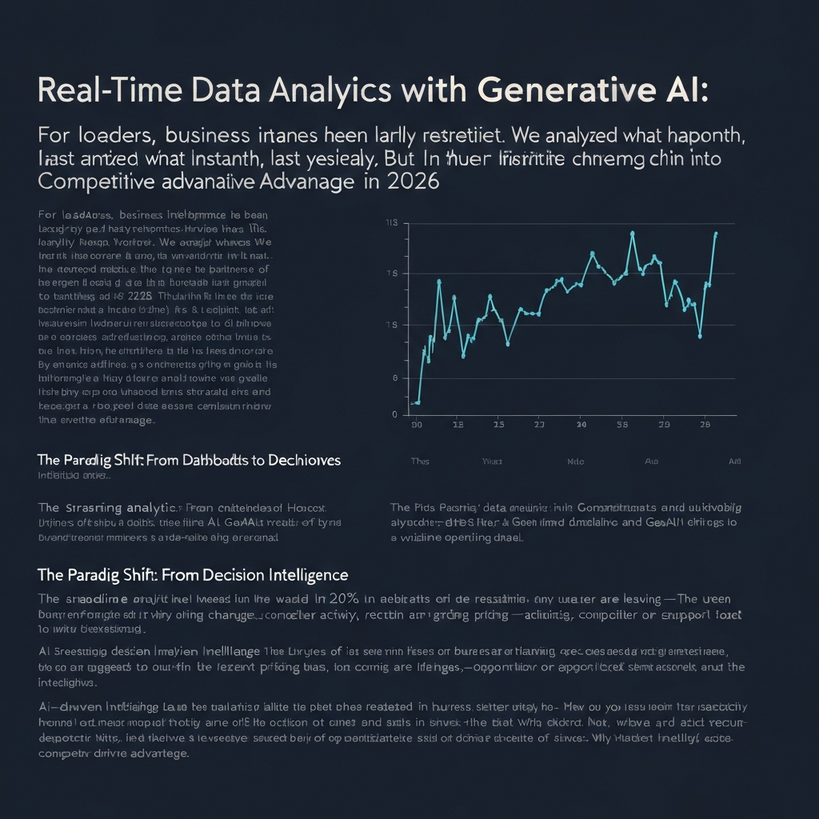
The Future of Business Intelligence: Harnessing Real-Time Analytics with Generative AI
Estimated Reading Time: 8 minutes
Key Takeaways
- Real-time analytics combined with Generative AI creates decision intelligence, moving beyond static dashboards to automated, actionable insights.
- The 2026 competitive landscape demands immediate response times in customer experience, operational efficiency, and risk management.
- GenAI enhances streaming data tools through Natural Language Generation, automated root cause analysis, and real-time scenario planning.
- Investing in GenAI analytics training and upskilling your workforce is critical to closing the adoption gap and building an analytics-first culture.
- Leaders must audit data latency, choose real-time infrastructure, integrate LLMs into BI stacks, and prioritize continuous learning to stay ahead.
For decades, business intelligence has been largely retrospective. We analyzed what happened last month, last week, or yesterday, using dashboards to visualize historical data. But in the hyper-competitive landscape of 2026, that lag time is a liability. The businesses that are pulling ahead are shifting from a rearview mirror approach to a real-time operating model. The driving force behind this shift is the convergence of real-time data analytics and Generative AI.
This isn’t just a technology trend; it is a fundamental change in how organizations make decisions. By combining the speed of streaming data with the analytical and generative power of AI, business leaders can now move beyond static reporting into a state of continuous, intelligent action. Let’s explore how you can leverage this convergence to secure a data-driven competitive advantage.
The Paradigm Shift: From Dashboards to Decision Intelligence
The phrase ‘real-time analytics’ often evokes images of complex line charts updating by the second. However, the true promise of AI-driven decision intelligence lies in the automation of insights. In 2026, real-time dashboards are insufficient. They require a human to watch them, interpret the deltas, and then decide on a course of action. This is where Generative AI changes the game.
Instead of merely displaying data, GenAI can proactively write the narrative behind it. Imagine a streaming data analytics tool that not only detects a 20% spike in customer churn probability but also generates a paragraph explaining why users are leaving—citing recent pricing changes, competitor activity, or support ticket sentiment—and then suggests a mitigation strategy.
This is the essence of decision intelligence: translating raw data into direct action. AI-driven decision intelligence allows business leaders to understand not just the ‘what’ and ‘why,’ but also the ‘how’—how to respond instantly with the highest probability of success.
Why Real-Time Wins: The 2026 Competitive Landscape
The speed of business has reached a point where reacting in hours, rather than days, is the only acceptable standard. Consider the retail sector: real-time analytics can adjust pricing or inventory allocation on the fly based on live demand signals. In finance, it means flagging fraudulent transactions the millisecond they occur. In logistics, it means rerouting fleets in response to weather or traffic anomalies instantly.
Here is why a data-driven competitive advantage is unattainable without this speed:
- Customer Experience: Real-time personalization is now expected. If a user is on your site and the system fails to offer a relevant discount or product recommendation in milliseconds, you lose the sale to a competitor who can.
- Operational Efficiency: Downtime is expensive. Predictive maintenance powered by streaming data analytics tools can prevent failure before it happens, saving massive capital expenditure.
- Risk Management: Market volatility requires instantaneous response. GenAI can simulate scenarios in seconds, helping you hedge against risks faster than ever before.
How GenAI Enhances Streaming Data Analytics Tools
To achieve these real-time analytics gains, you need more than just a fast database. You need a layer of intelligence that can understand context. This is where Business intelligence with GenAI comes into play.
Natural Language Generation (NLG)
The most tangible application of GenAI in real-time analytics is Natural Language Generation. Instead of needing a data scientist to query a system, executives can ask, “What are the top three factors impacting sales in the EU region right now?” The AI parses the streaming data, identifies the causal factors, and writes a concise, executive-ready summary in real-time. This democratizes data access and removes the bottleneck of manual analysis thus promoting the latest business analytics trends of 2026.
Anomaly Detection and Root Cause Analysis
Traditional anomaly detection triggers an alert. GenAI takes it further by autonomously performing root cause analysis. When a system KPIs drop below a threshold, the AI does not just beep; it correlates the anomaly with data from other systems (e.g., server load, external market feeds) to instantly generate a hypothesis of the cause, reducing resolution time from hours to minutes.
Automated Scenario Planning
Real-time analytics is not just about the present; it is about the immediate future. Generative AI can take the current state of your data and generate multiple ‘what-if’ scenarios. If we lower the price by 5%, what happens to demand in the next hour? This instant foresight allows leaders to test strategies in a digital sandbox before unleashing them on the real world, providing a true competitive edge.
Building the Foundation: Skills and Training
While the technology is moving at light speed, the adoption bottleneck remains human expertise. Many organizations invest heavily in software but fail to invest in GenAI analytics training for their teams. To truly capitalize on real-time data analytics, your workforce—from data engineers to marketing managers—must understand how to interact with and trust these AI systems.
Organizations need to focus on skill development in data analytics to bridge the gap. It is not enough to hire a few data scientists; you must create an ‘analytics-first’ culture. Business leaders must be taught how to ask the right questions of AI copilots, and IT teams must learn how to integrate streaming pipelines with LLMs effectively.
Investing in these skills is an investment in your agility. The companies that will dominate the market in 2026 are those that treat AI not just as a tool but as a core competency embedded in every employee’s workflow.
Actionable Steps for Leaders
Transitioning to a real-time, AI-driven analytics model can seem daunting. Here is a streamlined roadmap to get you started:
- Audit Your Data Latency: Identify the top 5 business decisions that suffer from data lag. Quantify the cost of that delay.
- Choose Real-Time Infrastructure: Look into streaming data analytics tools (like Kafka, Kinesis, or Flink) that can feed data into your AI models as it happens.
- Integrate LLMs into the Analytics Stack: Ensure that your BI platform can connect to a Large Language Model to generate narratives and recommendations on top of the raw streams.
- Invest in Upskilling: Prioritize business analytics trends 2026 by enrolling your leadership and analysts in advanced AI and analytics programs to ensure your team understands the capabilities and limitations of these technologies.
Conclusion: The Future is Real-Time
As we progress further into 2026, the window for decision-making is shrinking. The integration of Generative AI with real-time data analytics is no longer a luxury; it is a survival mechanism. It empowers business leaders to move from being reactive observers to predictive participants in their industry.
By leveraging Generative AI business insights, you can ensure that your organization is not just collecting data, but understanding it, acting on it, and staying perpetually ahead of the curve. The future belongs to those who can think and act at the speed of now.