
Why 2026 Is the Tipping Point for AI Product Management
Estimated reading time: 8 minutes
Key Takeaways
- AI product management is one of the fastest-growing roles in tech, with demand far outstripping supply heading into 2026.
- Success requires a blend of data literacy, AI/ML fundamentals, product strategy, and cross-functional leadership.
- A targeted training roadmap—from auditing transferable skills to building an AI portfolio—can accelerate your transition.
- Salary premiums for AI product managers often exceed traditional PM roles by 20–30%.
- The path is not a leap—it is a series of deliberate, achievable steps.
Table of Contents
- Why 2026 Is the Tipping Point for AI Product Management
- What Makes AI Product Management Different
- Core Skills You Need for an AI Product Management Career in 2026
- How to Transition to AI Product Management
- The 2026 Outlook: High-Demand Tech Careers
- Upskilling for AI Product Roles: A Roadmap
By 2026, AI will no longer be a feature—it will be the foundation of how products are conceived, built, and scaled. For data and digital professionals, this shift creates a rare window: the chance to move into AI product management, a role that sits at the intersection of business strategy, user empathy, and machine learning. Companies are actively seeking leaders who can translate model outputs into customer value, and the demand far outstrips supply. If you have a background in data analytics, software development, or digital marketing, you already possess the raw materials. This article maps the career path, skills, and training you need to lead AI-powered product innovation in 2026.
What Makes AI Product Management Different
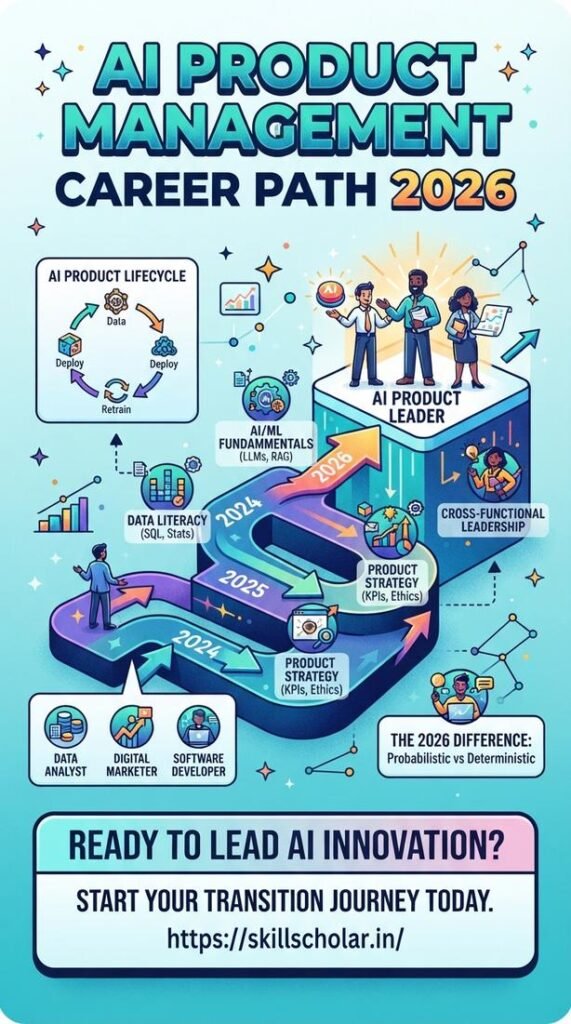
Traditional product management focuses on deterministic features: a button works, a workflow completes. AI product management deals with probabilistic systems where outcomes vary. An AI product manager must define success metrics for models that improve over time, manage data pipelines as a core product asset, and navigate ethical and regulatory landscapes. Beyond the technical, you become a translator—helping engineers understand user pain points and helping stakeholders understand model limitations. This cross-functional AI team leadership is the defining skill of the role.
The AI Product Lifecycle
AI product lifecycle management differs from standard SDLC. It includes data collection, model training, validation, deployment, monitoring, and retraining. Each stage introduces product decisions: How much training data is enough? What is an acceptable false-positive rate? How do you version a model without breaking user trust? As an AI product manager, you will own these trade-offs. For example, a generative AI product roadmap must account for hallucination rates, latency, and cost per inference—not just feature releases.
Core Skills You Need for an AI Product Management Career in 2026
To transition successfully, you need a blend of technical fluency and strategic thinking. Here are the high-impact AI product manager skills:
- Data literacy: Understand SQL, basic statistics, and how to read a confusion matrix. You do not need to build models, but you must challenge them.
- AI/ML fundamentals: Know the difference between supervised, unsupervised, and reinforcement learning. Understand concepts like embeddings, fine-tuning, and RAG (retrieval-augmented generation).
- Product strategy: Define AI product strategy that ties model capabilities to business KPIs. Where does AI create defensibility? Where does it just add cost?
- User research for AI: Users forgive imperfect AI if it saves time. You must design feedback loops and set expectations through UX.
- Cross-functional AI team leadership: Work with data scientists, ML engineers, ethicists, and legal. Speak each group’s language.
- Ethics and governance: Understand bias, privacy, and compliance. Trust is a product feature.
Data skills for product managers are non-negotiable. If you come from a digital background, start by taking a course in machine learning for product managers. If you are a data analyst, focus on product discovery and roadmap prioritization.
How to Transition to AI Product Management
Step 1: Audit Your Transferable Skills
Digital marketers understand user journeys; data analysts understand metrics; developers understand technical constraints. Map these to AI product needs. For example, a data analyst already knows how to measure model performance. A digital professional knows how to position AI features to customers.
Step 2: Get Targeted Training
AI product management training should cover the AI product lifecycle, prompt engineering, and model evaluation. Look for product management certification 2026 programs that include hands-on projects with real datasets. Skill Scholar offers specialized tracks that combine data skills with product strategy—ideal for working professionals.
Step 3: Build an AI Portfolio
Nothing speaks louder than a shipped project. Consider an AI product manager internship or a capstone where you define a generative AI product roadmap. Document your decisions: why you chose a certain model, how you measured success, what you would change. This becomes your interview narrative.
Step 4: Target the Right Roles
Search for “Associate AI Product Manager” or “AI Product Owner.” Many companies blend AI into existing product roles. You can also move internally—volunteer to lead an AI pilot in your current company.
The 2026 Outlook: High-Demand Tech Careers
By 2026, AI product management will be one of the high-demand tech careers. According to industry forecasts, demand for AI product managers will grow faster than for general product managers. Companies in healthcare, finance, retail, and SaaS are all hiring. The salary premium is significant—often 20–30% above traditional PM roles. But the competition is also rising. The differentiator will be proven ability to lead AI-powered product innovation from concept to measurable impact.
Upskilling for AI Product Roles: A Roadmap
Start with a foundation in data skills for product managers—SQL, experimentation, and metrics. Then add AI-specific knowledge: take a course on generative AI and product. Next, practice cross-functional AI team leadership by running a small project. Finally, pursue a product management certification 2026 that signals your commitment. Skill Scholar’s program is designed for data and digital professionals who want to lead, not just participate.
The path to AI product management is not a leap—it is a series of deliberate steps. With the right training, portfolio, and mindset, you can be leading AI-powered product innovation by 2026. The question is not whether you can transition, but how quickly you will start.