
Digital Twin Technology & AI in 2026: How Data Professionals Can Build Virtual Simulations That Optimize Real-World Business Performance
Estimated reading time: 9 minutes
Key Takeaways
- Digital twins have evolved from futuristic concepts into core business infrastructure across manufacturing, energy, healthcare, and logistics by 2026.
- AI-powered digital twins, real-time analytics, and standardized IoT integration have reshaped the field into continuous optimization engines.
- Data professionals need a blend of simulation skills, data science, IoT integration, and real-time analytics to succeed in this expanding field.
- A structured career roadmap—from core data skills to specialized digital twin training and hands-on internships—accelerates the transition into this high-demand role.
- The future of digital twins is autonomous, interconnected, and insight-driven, with professionals expected to translate twin data into strategic business action.
Table of Contents
- What Digital Twin Technology Looks Like in 2026
- Digital Twin vs Simulation: Understanding the Difference
- Why Businesses Are Investing in Digital Twins
- The Skills Data Professionals Need
- Building a Digital Twin Career Roadmap for 2026
- How Skill Scholar Supports Your Digital Twin Journey
- The Future of Digital Twins
- Conclusion
Digital twin technology has moved from futuristic concept to core business infrastructure. By 2026, organizations across manufacturing, energy, healthcare, and logistics rely on virtual replicas of physical assets to predict failures, optimize operations, and reduce costs. For data professionals, this shift creates a powerful career opportunity—but only for those who understand how to build, integrate, and interpret these intelligent simulations.
This guide explores the state of digital twin technology in 2026, the AI skills driving demand, and the practical steps data professionals can take to become indispensable in this rapidly expanding field.
What Digital Twin Technology Looks Like in 2026
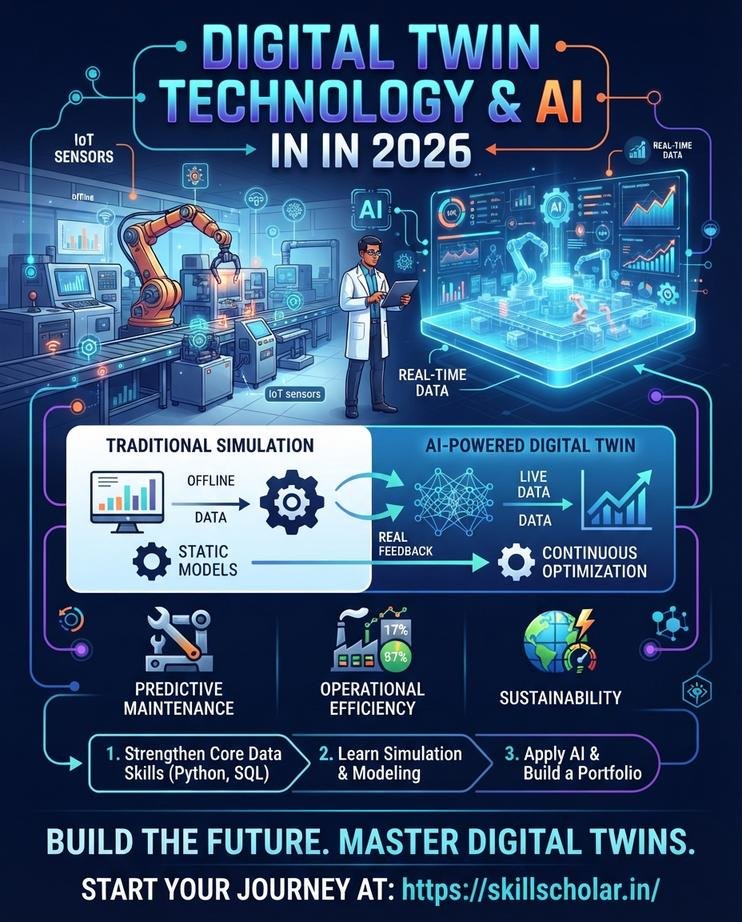
A digital twin is a virtual representation of a physical object, process, or system that is updated with real-time data. Unlike traditional simulations, which model hypothetical scenarios offline, digital twins maintain a live connection to their physical counterparts through IoT sensors, edge devices, and cloud platforms.
By 2026, three advances have reshaped the field:
- AI-powered digital twins now learn from streaming data and adjust their models autonomously.
- Real-time digital twin analytics enables decision-making at the edge, reducing latency.
- IoT digital twin integration has become standardized, allowing organizations to onboard assets rapidly.
The result is a shift from static modeling to continuous optimization. Digital twins no longer just describe what happened—they recommend what to do next.
Digital Twin vs Simulation: Understanding the Difference
Many professionals confuse digital twins with simulation. The distinction matters for anyone pursuing a digital twin career path.
| Feature | Traditional Simulation | Digital Twin |
|---|---|---|
| Data connection | Offline, historical | Real-time, continuous |
| Purpose | Test scenarios | Monitor and optimize |
| AI integration | Limited | Core to operation |
| Lifecycle | Project-based | Asset lifecycle |
A simulation asks, “What if we change this parameter?” A digital twin asks, “What is happening now, and what should we do about it?” This continuous feedback loop is what makes digital twins so valuable for business optimization.
Why Businesses Are Investing in Digital Twins
Organizations adopting digital twins in 2026 report measurable gains across several areas:
Predictive Maintenance Digital Twin
Equipment failures cost manufacturers billions annually. Predictive maintenance digital twins analyze sensor data to forecast failures before they occur, reducing unplanned downtime by up to 40% in some deployments.
Operational Efficiency
Digital twins for business optimization allow teams to test process changes virtually before committing resources. A logistics company can simulate route changes, a factory can model production line adjustments, and a hospital can optimize patient flow—all without disrupting live operations.
Sustainability and Energy Management
Digital twins help organizations track and reduce energy consumption by identifying inefficiencies in real time. This has become a regulatory and financial priority across industries.
The Skills Data Professionals Need
Building and maintaining digital twins requires a blend of data science, engineering, and domain knowledge. The most in-demand skills for 2026 include:
- Simulation and predictive modeling skills: Understanding physics-based models, machine learning forecasting, and hybrid approaches.
- Data science for digital twins: Working with time-series data, sensor streams, and anomaly detection.
- IoT digital twin integration: Connecting devices, managing data pipelines, and ensuring data quality.
- Real-time digital twin analytics: Building dashboards and alerting systems that operate at low latency.
- Cloud and edge computing: Deploying models where they are needed most.
These skills are not learned in isolation. Effective digital twin professionals combine technical depth with an understanding of the business context in which the twin operates.
Building a Digital Twin Career Roadmap for 2026
A structured approach helps data professionals transition into this field. Here is a practical roadmap:
Step 1: Strengthen Core Data Skills
Start with Python, SQL, and statistics. These fundamentals underpin every digital twin project. Focus on time-series analysis and data pipeline development.
Step 2: Learn Simulation and Modeling
Study discrete event simulation, system dynamics, and physics-informed machine learning. Understand when to use each approach and how to validate models against real-world data.
Step 3: Gain IoT and Integration Experience
Digital twins depend on reliable data streams. Learn how to work with sensor data, message brokers like MQTT, and cloud IoT platforms.
Step 4: Apply AI to Twin Development
Explore how machine learning improves twin accuracy and predictive capability. Focus on anomaly detection, remaining useful life estimation, and reinforcement learning for optimization.
Step 5: Build a Portfolio Through Projects
Employers value demonstrated experience. Build a small digital twin project—perhaps modeling a simple machine or process—and document your approach, challenges, and results.
Step 6: Pursue Specialized Training
A digital twin training program can accelerate your progress by providing structured learning, mentorship, and real-world case studies. Look for programs that cover both technical implementation and business application.
Step 7: Gain Practical Exposure
A digital twin internship online offers hands-on experience with real datasets and tools. This is particularly valuable for professionals transitioning from adjacent fields like data analysis or software development.
How Skill Scholar Supports Your Digital Twin Journey
At Skill Scholar, we design learning experiences that bridge the gap between theory and application. Our programs focus on the skills employers are hiring for in 2026:
- Hands-on projects using real IoT and simulation data
- Training in AI-powered digital twin development
- Guidance on building a digital twin career roadmap
- Access to online internships that provide practical experience
Whether you are a data analyst looking to specialize or an engineer expanding into data science, our training helps you build the competencies that matter.
The Future of Digital Twins
Looking ahead, digital twins will become more autonomous, more interconnected, and more accessible. AI will handle more of the model maintenance, allowing professionals to focus on strategy and business outcomes. Organizations will expect data professionals to not only build twins but to translate their insights into action.
The demand for professionals skilled in simulation and predictive modeling is not slowing down. By building the right skills now, you position yourself at the center of a technology transformation that will define how businesses operate for the next decade.
Conclusion
Digital twin technology in 2026 is a career opportunity grounded in real, growing demand. Data professionals who invest in simulation skills, IoT integration knowledge, and AI-powered modeling will find themselves in high demand across industries. The path requires deliberate learning and practical experience, but the rewards—both in career growth and impact—are substantial.
Start building your digital twin career roadmap today. Explore Skill Scholar’s training programs and take the first step toward mastering the skills that will define the next era of business optimization.