
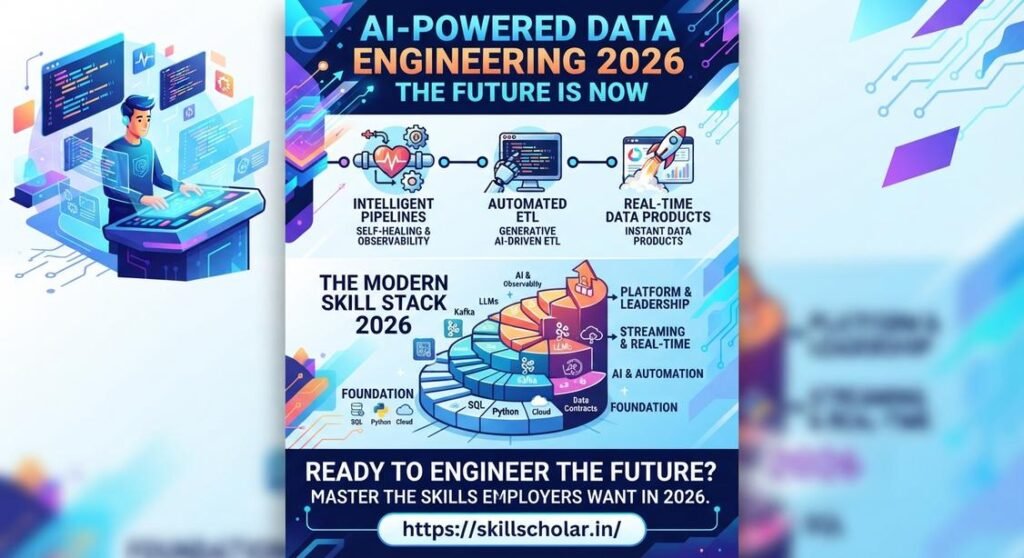
AI-Powered Data Engineering 2026: Build Intelligent Pipelines, Automated ETL & Real-Time Data Products
Estimated reading time: 8 minutes
Key Takeaways
- AI is now core to modern data platforms—not a bolt-on—reshaping how teams design, build, and operate pipelines.
- Intelligent data pipelines can self-heal, detect anomalies, and optimize costs automatically, cutting the 40–60% of an engineer’s week spent on manual toil.
- Generative AI accelerates automated ETL workflows, but human judgment on modeling, governance, and testing remains essential.
- Real-time data products—APIs, event streams, and embedded analytics—are the new deliverable and a fastest-growing skill area for 2026.
- Project-driven upskilling and internship experience consistently outperform certificates alone in the hiring market.
Table of Contents
- Why AI Is Rewriting the Data Engineering Playbook
- Intelligent Data Pipelines: From Brittle to Self-Healing
- Automated ETL Workflows Powered by Generative AI
- Real-Time Data Products: The New Deliverable
- The Data Engineering Career Path in 2026
- How to Upskill Effectively
- Why Skill Scholar
- Final Thoughts
Data engineering is undergoing its biggest transformation in a decade. In 2026, AI is no longer a bolt-on feature—it sits at the core of how modern data teams design, build, and operate their platforms. From self-healing pipelines to generative AI that writes and repairs ETL code, the discipline is being reshaped fast. For professionals and aspiring engineers, understanding AI-powered data engineering 2026 is no longer optional—it is the baseline for staying competitive.
At Skill Scholar, we train the next generation of data professionals on exactly these skills. This guide breaks down what is changing, why it matters, and how to position yourself for the high-demand data engineering roles of 2026.
Why AI Is Rewriting the Data Engineering Playbook
Traditional data engineering relied on hand-coded pipelines, brittle scheduling, and constant firefighting. AI changes the economics of that work. Intelligent data pipelines can now detect schema drift, reroute failed jobs, and optimize compute costs automatically. Automated ETL workflows reduce the manual toil that once consumed 40–60% of an engineer’s week.
The result: data engineers shift from writing boilerplate to designing systems, governing data quality, and building real-time data products that drive business decisions. That shift is precisely why demand for AI-literate data engineers is surging across fintech, healthcare, retail, and SaaS.
Intelligent Data Pipelines: From Brittle to Self-Healing
An intelligent data pipeline combines observability, machine learning, and automation. Instead of waiting for a dashboard to break, AI-powered monitoring predicts anomalies before they impact downstream consumers.
Key capabilities defining pipelines in 2026 include:
- Anomaly detection that flags unusual data volumes, null spikes, or latency in real time.
- Self-healing orchestration that retries, reroutes, or scales resources without human intervention.
- Cost-aware optimization that adjusts compute based on workload patterns.
- Lineage intelligence that traces data from source to dashboard for faster root-cause analysis.
Engineers who can architect these pipelines—using tools like Apache Airflow, dbt, Kafka, and modern orchestration platforms—are in immediate demand.
Automated ETL Workflows Powered by Generative AI
Generative AI for data pipelines is one of the most practical applications of LLMs in engineering. Instead of hand-writing transformation logic, engineers now prompt models to generate SQL, dbt models, and pipeline configurations—then review and refine.
This does not eliminate the engineer. It elevates the role. Automated ETL workflows still require human judgment on data modeling, governance, testing, and business logic. The engineers who thrive are those who can direct AI tools effectively, validate their output, and design systems that remain reliable at scale.
Practical examples include:
- LLM-assisted SQL generation and documentation.
- Automated test generation for data quality checks.
- Natural-language interfaces for exploring datasets.
- AI-driven schema mapping across heterogeneous sources.
Real-Time Data Products: The New Deliverable
Increasingly, companies are not shipping dashboards—they are shipping real-time data products. These are APIs, event streams, and embedded analytics that power customer-facing features and operational decisions in the moment.
Building real-time data products requires engineers who understand streaming architectures (Kafka, Flink, Spark Structured Streaming), latency budgets, and data contracts. It also requires a product mindset: treating data as something with consumers, SLAs, and lifecycle management. This is one of the fastest-growing skill areas in the data engineering career path 2026.
The Data Engineering Career Path in 2026
What does career progression look like now? The modern path is less linear and more skill-stacked:
- Foundation — SQL, Python, data modeling, cloud fundamentals.
- Pipeline engineering — orchestration, ETL/ELT, modern data stack tools.
- AI-augmented engineering — LLM integration, automated testing, observability.
- Platform & product — real-time data products, governance, data contracts.
- Leadership — architecture, strategy, and team enablement.
High-demand data engineering roles in 2026 include analytics engineer, streaming data engineer, data platform engineer, and AI data infrastructure specialist. Salaries reflect the scarcity of these skills, and employers consistently prioritize candidates with hands-on project experience over certificates alone.
How to Upskill Effectively
Data engineering upskilling works best when it is project-driven. Reading about pipelines is not the same as building one. Prioritize:
- Hands-on labs with real datasets and modern tooling.
- Portfolio projects that demonstrate intelligent pipelines and automated ETL.
- Mentorship from working engineers.
- Internship experience — even remote—to bridge theory and production practice.
A structured data engineering internship online can be a decisive advantage, giving you real pipeline ownership, code review experience, and the confidence to interview well.
Why Skill Scholar
Skill Scholar specializes in modern data stack training designed for the AI era. Our programs combine live instruction, real-world projects, and internship-style experience so you graduate with demonstrable skills—not just theory. Whether you are breaking into data engineering or leveling up into intelligent pipeline architecture, our curriculum is built around what employers actually hire for in 2026.
Final Thoughts
The shift to AI-powered data engineering is already underway. Intelligent data pipelines, automated ETL workflows, and real-time data products are defining the next generation of data platforms—and the engineers who build them. The professionals who invest in these skills now will lead the field for years to come.
Ready to build the skills that matter? Explore Skill Scholar’s data engineering programs and start engineering for 2026 today.