
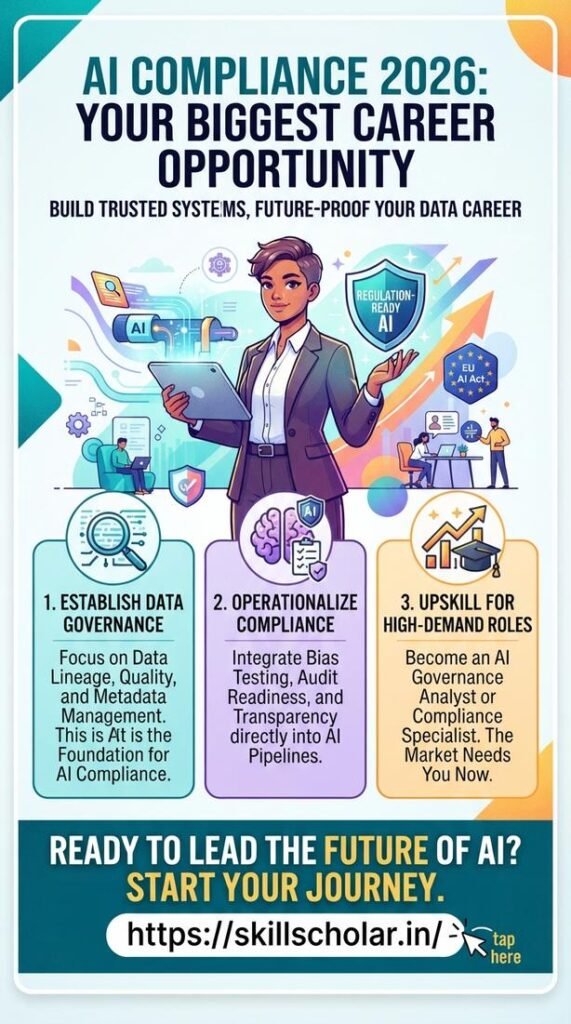
Data Governance and AI Compliance in 2026: The Career Opportunity Every Data Professional Needs to Know
Estimated reading time: 9 minutes
Key Takeaways
- AI regulation in 2026 has moved from voluntary guidance to enforceable law, and data governance is now the control plane that keeps AI systems lawful and trusted.
- Employers are hiring for hybrid roles that combine technical data skills with regulatory awareness, not lawyers who code or engineers who read statutes.
- Regulation-ready AI systems are built into the data foundation: lineage, documentation, quality controls, bias testing, and continuous monitoring.
- The data governance career path has expanded into new branches such as AI governance analyst, AI compliance specialist, and responsible AI program lead.
- The fastest way to future-proof your career is to formalize your governance foundation, add AI-specific compliance knowledge, earn credible credentials, and gain practical experience.
Table of Contents
- Introduction
- Why 2026 Is a Turning Point for Data Governance and AI Compliance
- The Skills Organizations Are Desperately Hiring For
- How to Build Regulation-Ready AI Systems
- Future-Proofing Your Career: The Data Governance Career Path in 2026
- The Bottom Line
Introduction
In 2026, artificial intelligence is no longer an experimental technology confined to innovation labs. It is embedded in loan approvals, medical diagnostics, hiring decisions, and public services. With that mainstream adoption comes a wave of regulatory scrutiny unlike anything the data profession has faced before. The EU AI Act is now enforceable, the U.S. has advanced its AI Bill of Rights framework into agency-level guidance, and similar legislation is emerging across Asia, Latin America, and the Middle East. For data professionals, this is not a threat. It is the single largest career opportunity of the decade.
At Skill Scholar, we work with data practitioners at every stage of their careers, from interns to principal architects. The message we hear consistently is the same: organizations are desperate for professionals who understand both data and regulation. They do not need lawyers who can code, and they do not need engineers who can read statutes. They need data governance specialists who can operationalize compliance inside data pipelines, metadata systems, and model lifecycle processes. That is precisely what this article will explore.
Why 2026 Is a Turning Point for Data Governance and AI Compliance
The regulatory landscape has shifted from guidance to enforcement. Organizations that operated AI systems on voluntary principles now face mandatory requirements around transparency, risk management, data quality, human oversight, and post-market monitoring. The EU AI Act alone introduces obligations for high-risk AI systems that include documented data lineage, bias testing, and conformity assessments.
This is where traditional data governance becomes inseparable from AI compliance. High-risk AI systems depend on trustworthy training data. Trustworthy data depends on governance. Governance depends on metadata, lineage, quality controls, and stewardship. The entire stack now sits under regulatory audit. Data governance for AI is no longer a nice-to-have; it is the control plane that keeps AI systems lawful, explainable, and trusted.
The Skills Organizations Are Desperately Hiring For
When we review job postings in the data governance market, a clear pattern emerges. The highest-demand roles combine technical data skills with regulatory awareness and audit-ready documentation. Specifically, employers are looking for:
- Data quality and lineage skills — the ability to trace data from source to model and prove its accuracy and appropriateness.
- Metadata management skills — building and maintaining catalogs, glossaries, and lineage graphs that support transparency requirements.
- AI audit and risk management — conducting model risk assessments, bias evaluations, and post-market monitoring.
- Responsible data practices — implementing consent, minimization, and purpose limitation in an AI context.
What is striking is that these are not new skills; they are data governance skills applied to a new regulatory environment. Professionals who already understand master data management, data stewardship, and data quality now have a direct pathway into AI compliance roles.
How to Build Regulation-Ready AI Systems
A regulation-ready AI system is not built at the end of the development lifecycle. It is built into the data foundation. Here is the practical sequence we teach in our AI compliance training:
1. Establish Data Lineage and Documentation
Every high-risk AI system must be able to demonstrate where its training data came from, how it was processed, and whether it was appropriate for the intended use. This means lineage, cataloging, and versioning become mandatory capabilities, not optional metadata projects.
2. Implement Quality and Bias Controls
Regulators increasingly expect documented evidence of data quality and bias testing. Data professionals need to operationalize these controls within pipelines, not as one-off audits. Master data management training is highly relevant here, because authoritative reference data reduces the risk of hidden bias.
3. Map Regulatory Requirements to Data Controls
The most valuable skill in 2026 is translation: taking a regulatory clause and mapping it to a specific data control, a specific metadata attribute, or a specific audit artifact. This is the essence of data governance for AI.
4. Prepare for Audit and Monitoring
Post-market monitoring and audit readiness require governance processes that run continuously. AI audit and risk management skills are what separate compliance-ready organizations from those that scramble when regulators arrive.
Future-Proofing Your Career: The Data Governance Career Path in 2026
The data governance career path has expanded dramatically. Where once the trajectory ran from data steward to data governance manager, today there are new branches: AI governance analyst, AI compliance specialist, model risk data steward, and responsible AI program lead. These roles are well-compensated and in high demand.
How should a data professional prepare? Our advice is consistent with what we see in our upskilling programs:
- Formalize your governance foundation. Strengthen your knowledge of data quality, metadata, lineage, and stewardship. These remain the core of every AI governance role.
- Add AI-specific compliance knowledge. Pursue AI compliance training and EU AI Act compliance training that maps directly to the regulatory obligations you will face.
- Earn credible credentials. An AI governance certification signals to employers that you understand both data and regulation, which is the exact combination the market is short on.
- Get practical experience. A data governance internship online or a hands-on project implementing lineage, cataloging, or bias controls gives you the portfolio evidence employers want.
- Stay current. AI regulatory compliance 2026 is not a static field; it will continue to evolve, and continuous learning is now part of the job.
At Skill Scholar, we design our programs around exactly this progression. Our mission is to help data professionals become the people organizations trust to build and defend trusted AI data pipelines. Whether you are exploring a data stewardship career path, preparing for high-demand data governance roles, or seeking a data governance internship online to gain practical experience, the opportunity in 2026 is substantial.
The Bottom Line
AI regulation has transformed data governance from a back-office function into a board-level imperative. Organizations need professionals who can build regulation-ready AI systems, document them, monitor them, and defend them. Those professionals will be developed through deliberate upskilling, credible certifications, and practical experience. If you are a data professional, the question is no longer whether to specialize in AI compliance, but how quickly you can move. The market is already moving, and the professionals who move first will define the next generation of trusted AI.