
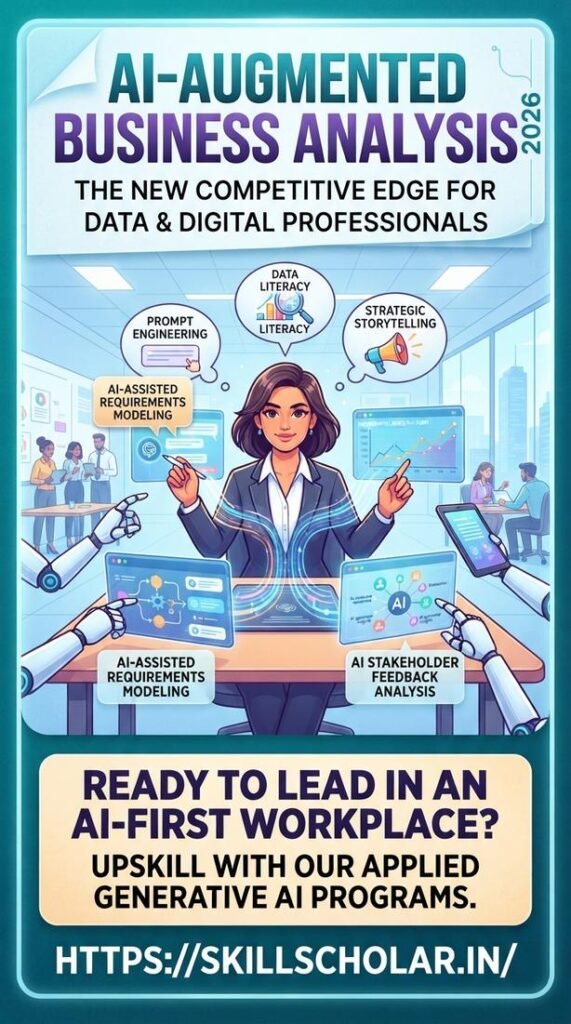
AI-Augmented Business Analysis 2026: The New Competitive Edge
Estimated Reading Time: 8 minutes
Key Takeaways
- AI-augmented business analysis in 2026 is about amplifying human judgment, not replacing it.
- Core business analyst AI skills include prompt engineering, AI-assisted requirements modeling, data validation, and strategic storytelling.
- Decision intelligence is the new deliverable—turning generative AI outputs into measurable business outcomes.
- The AI business analyst career path is expanding with high-demand roles in decision intelligence and digital transformation.
- Upskilling now through applied programs and certifications creates a durable competitive advantage.
Table of Contents
- AI-Augmented Business Analysis 2026: The New Competitive Edge
- What AI-Augmented Business Analysis Actually Means
- From Data Overload to Decision Intelligence
- Core Business Analyst AI Skills for 2026
- 1. Prompt Engineering and AI Tool Fluency
- 2. AI-Assisted Requirements and Process Modeling
- 3. Data Literacy and Validation
- 4. Strategic Storytelling and Stakeholder Influence
- AI Tools for Business Analysts: What to Learn First
- The AI Business Analyst Career Path in 2026
- Why Upskilling Now Matters
- Final Thoughts
Business analysis is undergoing its biggest transformation in decades. By 2026, generative AI has moved from a novelty to a core competency, and the business analysts who thrive will be those who treat AI as a strategic partner rather than a threat. AI-augmented business analysis 2026 is not about replacing human judgment—it is about amplifying it. For data and digital professionals, this shift represents a defining career opportunity: the chance to convert generative AI outputs into real decision intelligence that drives measurable business outcomes.
At Skill Scholar, we build training programs around this exact intersection—combining business analysis fundamentals with hands-on generative AI analytics training, so professionals can lead in an AI-first workplace.
What AI-Augmented Business Analysis Actually Means
AI-augmented business analysis blends traditional BA disciplines—requirements elicitation, stakeholder management, process modeling—with AI tools that accelerate and enrich each step. Instead of manually drafting requirements from interview transcripts, analysts now use AI-powered requirements gathering to extract themes, flag inconsistencies, and generate user stories in minutes. Instead of static dashboards, they use AI to simulate scenarios and surface hidden patterns.
The key distinction is augmentation, not automation. AI handles the heavy lifting of summarization and pattern detection, while the analyst supplies context, ethics, and strategic judgment. This is the foundation of decision intelligence: the discipline of turning data and AI insight into better business decisions.
From Data Overload to Decision Intelligence
Organizations are drowning in data but starving for insight. AI-augmented analysts bridge that gap by asking sharper questions, validating AI-generated hypotheses, and translating findings into executive-ready narratives. This is where data storytelling for business analysts becomes a superpower—numbers alone don’t move stakeholders; stories do.
Core Business Analyst AI Skills for 2026
To stay competitive, data and digital professionals should prioritize a focused set of business analyst AI skills:
1. Prompt Engineering and AI Tool Fluency
Knowing how to structure prompts for requirements generation, risk analysis, and stakeholder summaries is now table stakes. Familiarity with AI tools for business analysts—from LLM assistants to AI-enhanced process mining platforms—separates effective analysts from those left behind.
2. AI-Assisted Requirements and Process Modeling
Generative AI for business analysis can draft user stories, identify edge cases, and stress-test process flows. Skilled analysts learn to critique and refine these outputs rather than accept them blindly.
3. Data Literacy and Validation
AI can hallucinate. Analysts must validate AI-generated insights against source data, apply statistical reasoning, and document assumptions—skills central to any rigorous decision intelligence training.
4. Strategic Storytelling and Stakeholder Influence
Turning AI outputs into persuasive, decision-ready narratives is the differentiator. Data storytelling for business analysts is no longer soft skill territory—it is a core deliverable.
AI Tools for Business Analysts: What to Learn First
The market is crowded, so focus on categories rather than brand names. Prioritize:
- LLM assistants for requirements drafting, meeting synthesis, and documentation
- AI-enhanced analytics platforms for pattern discovery and forecasting
- Process mining with AI for identifying bottlenecks and automation opportunities
- AI survey and feedback tools for faster stakeholder voice analysis
Hands-on exposure matters more than theory. Structured programs with applied labs—like those at Skill Scholar—help professionals build confidence quickly.
The AI Business Analyst Career Path in 2026
The AI business analyst career path is expanding rapidly. High-demand business analyst roles in 2026 include AI-augmented BA, decision intelligence analyst, digital transformation analyst, and product analytics specialist. Employers increasingly expect familiarity with generative AI workflows alongside traditional BA competencies.
Entry points are diversifying too. A business analyst internship online can now provide real project exposure to AI-assisted analysis, giving early-career professionals a fast track. For mid-career data and digital professionals, a business analysis certification 2026 that explicitly covers generative AI and decision intelligence offers a credible signal of readiness.
Why Upskilling Now Matters
The window for early advantage is closing. As AI tools become standard, the differentiator will be judgment, storytelling, and strategic thinking—the human layer on top of AI output. Digital skills upskilling in 2026 must go beyond tool tutorials; it should build a durable decision intelligence skillset.
At Skill Scholar, our mission is to equip data and digital professionals with exactly this blend: rigorous business analysis foundations, applied generative AI analytics training, and communication skills that turn insight into action. Whether you are starting through an online internship or advancing with certification, the goal is the same—become the analyst who turns AI potential into strategic decision intelligence.
Final Thoughts
AI-augmented business analysis 2026 rewards professionals who combine curiosity with discipline. Learn the tools, validate the outputs, tell the story, and own the decision. The future of business analysis is not human versus AI—it is humans with AI, making smarter decisions faster. Position yourself on the right side of that equation.