
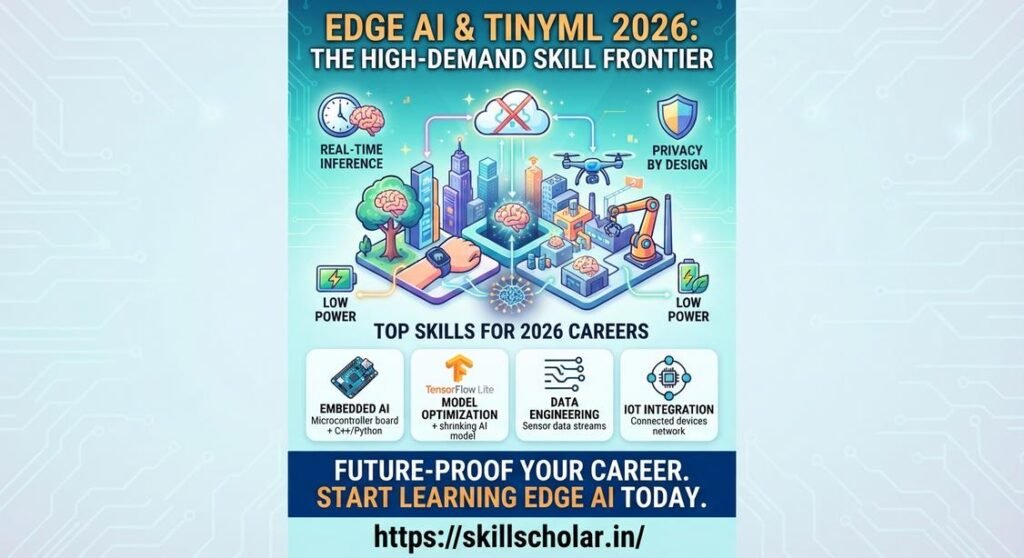
Edge AI & TinyML 2026: The Next High-Demand Skill Frontier for Data & Digital Professionals
Estimated Reading Time: 7 minutes
Key Takeaways
- Edge AI and TinyML are set to become among the most in-demand skills by 2026, reshaping how intelligence is deployed across industries.
- TinyML offers real-time inference, low power consumption, privacy by design, and cost efficiency—complementing rather than replacing cloud AI.
- Professionals need skills in embedded AI development, model optimization, edge data handling, and IoT integration to stay competitive.
- Hands-on experience through TinyML certification and Edge AI internship online programs is the fastest route into this frontier.
- Roles like Edge AI Engineer, TinyML Developer, and IoT Solutions Architect will dominate hiring by 2026.
Table of Contents
- What Is Edge AI and Why Does It Matter in 2026?
- TinyML vs Cloud AI: Why the Shift Is Happening
- High-Demand AI Skills for 2026
- Why Skill Scholar Is Your Partner in Edge AI Upskilling
- The Future of AI Deployment: What to Expect by 2026
- Start Building Your Edge AI Career Today
What Is Edge AI and Why Does It Matter in 2026?
The artificial intelligence landscape is shifting. While cloud-based AI has dominated headlines for the past decade, a quieter revolution is unfolding at the edge—inside sensors, wearables, cameras, drones, and industrial machines. By 2026, Edge AI and TinyML will be among the most sought-after skill sets for data scientists, ML engineers, and digital professionals. If you’re looking to future-proof your career, understanding on-device intelligence is no longer optional—it’s essential.
Edge AI refers to running machine learning models directly on local devices—like microcontrollers, smartphones, or IoT sensors—rather than sending data to a centralized cloud. TinyML is a subset of Edge AI focused on deploying ultra-lightweight models on resource-constrained hardware, often consuming milliwatts of power.
The appeal is undeniable: real-time inference, reduced latency, lower bandwidth costs, enhanced privacy, and operation in offline environments. From smart agriculture to predictive maintenance on factory floors, Edge AI is transforming how industries deploy intelligence.
By 2026, analysts predict billions of edge devices will run embedded AI workloads. Companies across manufacturing, healthcare, automotive, and retail are racing to hire professionals who can bridge data science and embedded systems.
TinyML vs Cloud AI: Why the Shift Is Happening
Cloud AI excels at heavy computation, but it has limitations: latency, connectivity dependency, and privacy concerns. TinyML flips the script by pushing inference to the device itself.
Key advantages of TinyML:
- Real-time inference at the edge – Decisions happen in milliseconds without a round trip to the cloud.
- Low-power AI models – Optimized for battery-operated devices.
- Privacy by design – Sensitive data never leaves the device.
- Cost efficiency – Less cloud compute and bandwidth consumption.
This isn’t about replacing cloud AI—it’s about complementing it. The professionals who thrive will be those who understand both paradigms.
High-Demand AI Skills for 2026
So what specific skills should you build? Here’s a roadmap for data and digital professionals:
1. Embedded AI Development
Learn to work with microcontrollers like Arduino, Raspberry Pi, ESP32, and ARM Cortex-M. Understanding C/C++ and Python for embedded environments is foundational.
2. Model Optimization Techniques
Quantization, pruning, and knowledge distillation let you shrink models to fit on tiny devices without sacrificing accuracy. TensorFlow Lite, Edge Impulse, and ONNX are key tools.
3. Data Skills for Edge Computing
Edge data is noisy, sparse, and often unlabeled. Skills in sensor data preprocessing, feature engineering, and on-device learning are in high demand.
4. IoT and TinyML Integration
Connecting edge models to IoT ecosystems—MQTT, LoRaWAN, BLE—enables end-to-end intelligent systems.
5. Edge AI Career Roadmap
Start with Python and ML basics, progress to TinyML frameworks, build portfolio projects, and pursue a TinyML certification or Edge AI internship online to gain real-world experience.
Why Skill Scholar Is Your Partner in Edge AI Upskilling
At Skill Scholar, we specialize in future-focused training that bridges theory and practice. Our TinyML training program is designed for data professionals, engineers, and digital specialists who want to lead in the edge intelligence era.
What sets us apart:
- Hands-on Edge AI projects for portfolio – Build deployable models on real hardware.
- Expert-led curriculum – Learn from practitioners working in embedded AI and IoT.
- Edge AI internship online – Gain industry experience from anywhere.
- TinyML certification – Validate your skills with a recognized credential.
Whether you’re a data scientist curious about embedded systems or an engineer wanting to add ML to your toolkit, our programs meet you where you are.
The Future of AI Deployment: What to Expect by 2026
By 2026, we’ll see:
- More AI chips designed specifically for edge workloads.
- AutoML tools that generate TinyML models automatically.
- Federated learning enabling collaborative edge intelligence.
- Regulations favoring on-device processing for privacy.
The professionals who master Edge AI career 2026 skills today will be positioned for roles like Edge AI Engineer, TinyML Developer, Embedded ML Specialist, and IoT Solutions Architect.
Start Building Your Edge AI Career Today
The demand for on-device machine learning skills is accelerating. Don’t wait until the market is saturated. Skill Scholar offers the training, mentorship, and real-world projects you need to transition into this high-growth field.
Explore our TinyML training program and Edge AI internship online opportunities today. The future of AI is at the edge—and your career can be too.
Ready to lead in 2026? Join Skill Scholar and become an Edge AI professional.