
The Dawn of the Conversational Era: Why 2026 is the Tipping Point
Estimated Reading Time: 8 minutes
Key Takeaways
- Voice AI and conversational interfaces are becoming the primary operating layer for digital services by 2026, driven by LLMs and NLP advancements.
- Professionals need to master speech recognition and NLP, multimodal AI training, and prompt engineering for voice AI to stay competitive.
- Emerging roles like Conversational Designer, Voice Data Scientist, and AI Interaction Engineer are in high demand across healthcare, finance, automotive, and education.
- Voice AI upskilling programs and hands-on Conversational AI certification are critical for career advancement in the AI economy.
- Skill Scholar bridges the gap between theoretical knowledge and industry application through internships and curriculum aligned with 2026 trends.
Table of Contents
- The Dawn of the Conversational Era: Why 2026 is the Tipping Point
- The Evolution of Human-Machine Interaction
- Core Skills for the 2026 Voice AI Professional
- Navigating the Career Landscape: Opportunities and Roles
- How Skill Scholar Prepares You for the Voice Revolution
- Conclusion: Seize the Future of Interaction
The Dawn of the Conversational Era: Why 2026 is the Tipping Point
The novelty of asking a smart speaker for the weather has long worn off. We are now entering a phase where voice AI and conversational interfaces are no longer supplementary features—they are becoming the primary operating layer for digital services. By 2026, the global market for voice user interfaces is projected to skyrocket, driven by advancements in large language models (LLMs), natural language processing (NLP), and the demand for seamless human-machine interaction.
For data and digital professionals, this represents a massive career inflection point. It is not just about coding an app anymore; it is about engineering an experience that mimics human empathy, understands context, and executes complex tasks. Whether you are a data scientist, a UX designer, or a digital marketer, understanding the mechanics of voice technology is the key to remaining relevant in the next five years.
At Skill Scholar, we recognize that the gap between current digital skills and the demands of the voice-first future is widening. This blog explores how you can bridge that gap, build the next generation of human-machine interaction, and secure a high-demand role in the AI economy.
The Evolution of Human-Machine Interaction
To understand where we are going, we must look at how we got here. The transition from Graphical User Interfaces (GUI) to Conversational User Interfaces (CUI) is as significant as the jump from command-line interfaces to the mouse and keyboard.
From Clicks to Conversation
Traditional digital interfaces rely on the user learning a set of rules: click here, swipe there, type this. Voice AI flips the script—the machine must adapt to the user. This requires a fundamental shift in how we handle data and design systems. Conversational interface design is no longer just about visual hierarchy; it is about dialog flow, intent recognition, and personality injection.
The Role of Generative AI
By 2026, generative AI voice assistants will move beyond scripted responses. They will generate dynamic, context-aware replies in real-time. This shift requires professionals who understand not just how to build these models, but how to fine-tune them using prompt engineering for voice AI to ensure brand safety and user satisfaction.
Core Skills for the 2026 Voice AI Professional
Building a career in this domain requires a blend of technical data skills and creative digital strategy. Here are the pillars of voice AI development skills you need to master.
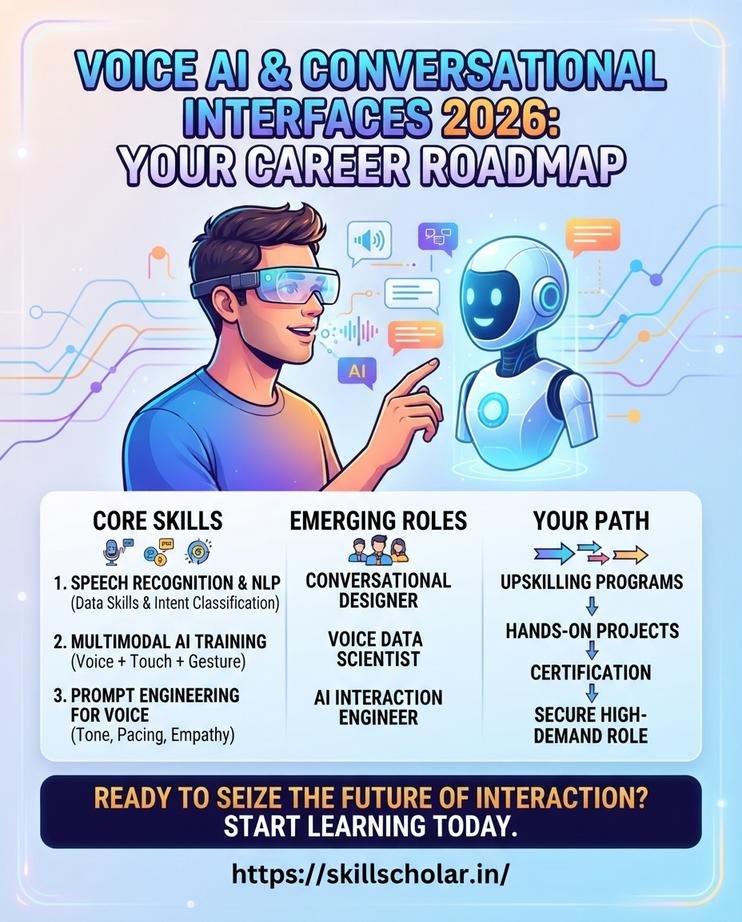
1. Speech Recognition and NLP
At the heart of any voice system is the ability to hear and understand. Speech recognition and NLP are the engines. Professionals need to understand how to clean audio data, train acoustic models, and handle the nuances of natural language.
- Data Skills for Voice Technology: Handling the massive datasets required to train models on different accents, dialects, and speaking styles.
- Intent Classification: Teaching machines to distinguish between a user asking a question versus issuing a command.
2. Multimodal AI Training
The future is not just voice; it is multimodal AI training. In 2026, interfaces will combine voice, touch, gesture, and visual cues. A user might point at a product on a screen and ask, “How much is this?” The AI must correlate the visual input with the verbal query. Professionals trained in multimodal integration will be the architects of these experiences.
3. Prompt Engineering for Voice
Prompt engineering has evolved. It is no longer just about text. Prompt engineering for voice AI involves designing system prompts that account for tone, pacing, and latency. A voice assistant that sounds robotic or takes too long to respond destroys trust. This is a specialized skill that blends psychology with technical writing.
Navigating the Career Landscape: Opportunities and Roles
The demand for high-demand AI skills 2026 is not limited to Silicon Valley giants. Healthcare, finance, automotive, and education are all desperate for talent who can implement AI voice assistant development.
Emerging Job Titles
If you are looking at the future of conversational interfaces, your job title might change. Look out for roles such as:
- Conversational Designer: Scripting dialogues and mapping user journeys.
- Voice Data Scientist: Analyzing voice interaction logs to improve model accuracy.
- AI Interaction Engineer: Building the backend systems that connect LLMs to voice front-ends.
The Importance of Upskilling
You cannot rely on a degree from five years ago. The tech stack for voice AI is evolving quarterly. This is where Voice AI upskilling programs become critical. Whether you are a developer learning to integrate APIs or a project manager trying to understand the limits of the technology, continuous learning is the only way to stay competitive.
How Skill Scholar Prepares You for the Voice Revolution
At Skill Scholar, our mission is to bridge the gap between theoretical knowledge and industry application. We understand that AI voice technology careers require a portfolio, not just a resume. Our curriculum is designed to simulate the real-world challenges you will face in the industry.
Hands-On Learning and Internships
We emphasize practical application. Through our Voice AI internship online opportunities, students work on live projects, analyzing datasets and building prototype conversational agents. This experience is invaluable when you sit in front of a hiring manager.
Comprehensive Certification
We offer a Conversational AI certification that validates your skills in a crowded market. Our courses cover the spectrum from Speech recognition and NLP to the ethical considerations of AI deployment. By covering Data skills for voice technology, we ensure you are not just a coder, but a well-rounded digital professional.
Curriculum Aligned with 2026 Trends
Our modules are constantly updated to reflect the latest industry standards. We focus on:
- Integrating Generative AI voice assistants into legacy systems.
- Advanced Speech recognition and NLP techniques.
- The intersection of voice and IoT (Internet of Things).
Conclusion: Seize the Future of Interaction
The transition to voice-first interfaces is not a fad; it is the natural evolution of computing. As we move towards 2026, the professionals who thrive will be those who can humanize technology. They will be the ones who understand that behind every AI voice assistant development project is a human need for connection and efficiency.
Don’t wait for the market to pass you by. Whether you are looking to pivot your career or enhance your current skill set, the time to master Voice AI and Conversational Interfaces is now. Join Skill Scholar and become a part of the generation that builds the bridge between humans and machines.
Ready to start your journey? Explore our Conversational AI training programs today and secure your place in the future of tech.