
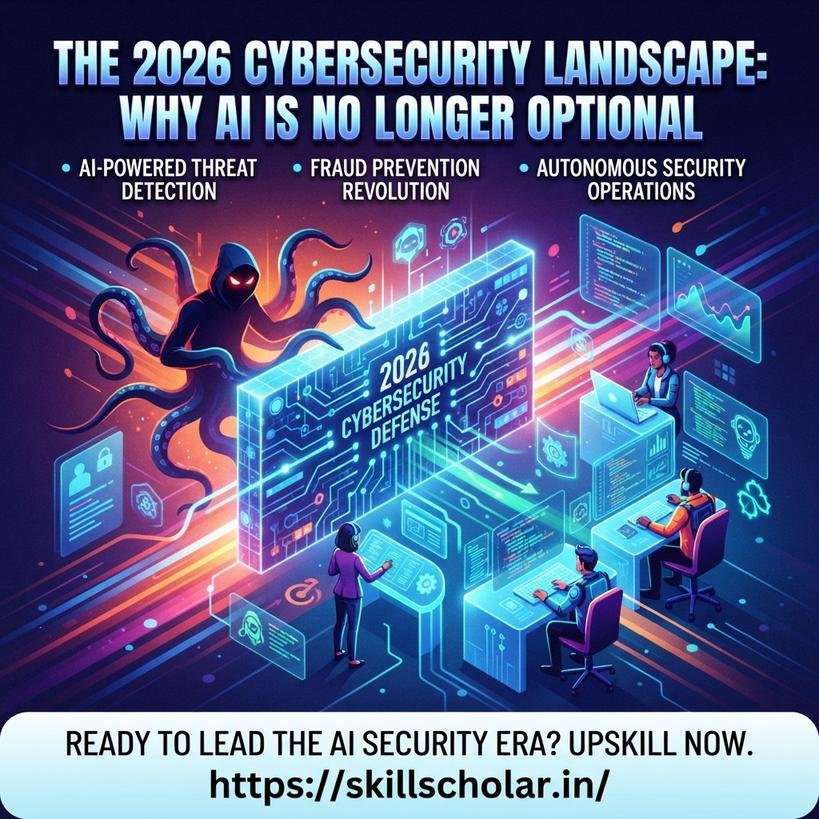
The 2026 Cybersecurity Landscape: Why AI Is No Longer Optional
Estimated reading time: 8 minutes
Key Takeaways
- AI-powered cybersecurity is now a core requirement, not a bonus skill, as cybercriminals deploy AI-generated phishing, polymorphic malware, and deepfake social engineering.
- Global cybercrime damages are projected to exceed $10.5 trillion annually, with 3.5 million unfilled security positions worldwide.
- Autonomous security operations, generative AI threat detection, and machine learning for fraud detection are the fastest-growing skill sets employers demand.
- High-demand roles like AI-Powered SOC Analyst, AI Security Engineer, and Fraud Data Scientist often pay over $150,000 for mid-level professionals.
- Early adopters who upskill within the next 18-24 months will capture outsized career rewards before the market saturates.
Table of Contents
- The 2026 Cybersecurity Landscape: Why AI Is No Longer Optional
- Key Takeaways
- What Makes 2026 Different for Cybersecurity Professionals?
- 1. AI vs. AI Warfare
- 2. The Rise of Autonomous Security Operations
- 3. Data Skills as the New Security Foundation
- Generative AI in Threat Detection: Real-World Applications
- Predictive Threat Intelligence
- Anomaly Detection at Scale
- Automated Incident Response
- The Fraud Prevention Revolution
- High-Demand Cybersecurity Roles in 2026
- How Skill Scholar Prepares You for the AI Security Era
- Hands-On, Project-Based Learning
- Curriculum Aligned with Industry Demand
- Career Support That Goes Beyond Resume Writing
- Why Upskilling Now Is Critical
- Take the First Step with Skill Scholar
By 2026, the cybersecurity battlefield has fundamentally changed. Cybercriminals now deploy AI-generated phishing campaigns, polymorphic malware, and deepfake social engineering attacks that bypass traditional defenses in seconds. According to industry forecasts, global cybercrime damages will exceed $10.5 trillion annually, and security teams face a staggering 3.5 million unfilled positions worldwide. The organizations that survive won’t be those with the biggest security budgets—they’ll be the ones with professionals who know how to weaponize AI-powered cybersecurity strategies effectively.
At Skill Scholar, we’ve built our entire curriculum around this reality. Our mission is simple: equip data and digital professionals with the generative AI threat detection skills that employers are desperately seeking in 2026.
What Makes 2026 Different for Cybersecurity Professionals?
The convergence of three forces has reshaped the industry:
1. AI vs. AI Warfare
Attackers now use large language models to automate reconnaissance, craft convincing pretexts, and scale attacks across thousands of targets simultaneously. Defenders must respond with machine learning for fraud detection systems that identify anomalies in real time.
2. The Rise of Autonomous Security Operations
Security Operations Centers (SOCs) can no longer rely on manual triage. Autonomous security operations—where AI agents investigate, correlate, and respond to threats without human intervention—have become the industry standard. Professionals who understand AI security automation are commanding premium salaries.
3. Data Skills as the New Security Foundation
Cybersecurity is no longer just about firewalls and antivirus software. It’s about data pipelines, feature engineering, and model training. Data skills for cybersecurity are now non-negotiable for career advancement.
Generative AI in Threat Detection: Real-World Applications
Let’s break down how generative AI is being deployed across the security stack:
Predictive Threat Intelligence
Generative models analyze historical attack patterns and global threat feeds to predict where the next breach will occur. AI-driven threat intelligence platforms can generate synthetic attack scenarios, allowing security teams to stress-test defenses before real adversaries strike.
Anomaly Detection at Scale
Traditional rule-based systems generate overwhelming false positives. Generative AI builds behavioral baselines for every user, device, and network segment, then flags deviations with 95%+ accuracy. This is generative AI security analytics in action.
Automated Incident Response
When a threat is detected, AI systems can isolate affected endpoints, revoke compromised credentials, and initiate forensic data collection—all within seconds. This is the promise of autonomous security operations.
The Fraud Prevention Revolution
Financial fraud has become an AI arms race. Synthetic identity fraud, account takeover, and transaction laundering are all supercharged by generative models. AI fraud prevention training teaches professionals to:
- Deploy GANs (Generative Adversarial Networks) to simulate fraudulent behavior and harden detection models
- Use natural language processing to detect social engineering attempts in real time
- Build ensemble models that combine supervised and unsupervised learning for maximum coverage
Companies in fintech, e-commerce, and banking are hiring aggressively for these skills—often with salaries exceeding $150,000 for mid-level roles.
High-Demand Cybersecurity Roles in 2026
If you’re wondering where the opportunities are, here are the positions seeing explosive growth:
- AI-Powered SOC Analyst – The frontline role has evolved. Today’s SOC analysts orchestrate AI tools, tune detection models, and interpret AI-generated threat narratives.
- AI Security Engineer – Builds and maintains the infrastructure that powers autonomous defense systems.
- Fraud Data Scientist – Specializes in machine learning for fraud detection across financial and e-commerce platforms.
- Threat Intelligence Analyst (AI-Focused) – Leverages generative AI to produce actionable intelligence reports.
These aren’t hypothetical roles. They’re being posted today on LinkedIn, Indeed, and company career pages—and they’re staying open for months due to talent shortages.
How Skill Scholar Prepares You for the AI Security Era
At Skill Scholar, we don’t teach theory in isolation. Our programs are designed by practitioners who’ve deployed AI security systems in production environments. Here’s what sets us apart:
Hands-On, Project-Based Learning
You’ll work with real datasets, build actual detection models, and deploy them in simulated SOC environments. Our cybersecurity internship online program gives you portfolio-ready projects that impress hiring managers.
Curriculum Aligned with Industry Demand
Every module maps directly to job requirements. From AI-powered SOC analyst fundamentals to advanced generative AI security analytics, you’ll learn exactly what employers need.
Career Support That Goes Beyond Resume Writing
We connect graduates with hiring partners, provide interview coaching specific to AI security roles, and offer ongoing mentorship as you advance in your career.
Why Upskilling Now Is Critical
The window of opportunity is closing. As AI security tools become more accessible, the premium on professionals who understand them will shift—but for the next 18-24 months, early adopters will capture outsized career rewards. Whether you’re a data analyst looking to pivot, a developer interested in security, or an IT professional wanting to future-proof your career, AI in cybersecurity career pathways offer the fastest route to high-demand, high-compensation roles.
The question isn’t whether AI will transform cybersecurity. It already has. The question is: will you be the professional driving that transformation, or the one being replaced by it?
Take the First Step with Skill Scholar
Skill Scholar exists to bridge the gap between traditional tech education and the AI-driven demands of 2026’s cybersecurity landscape. Our cybersecurity AI upskilling programs are built for working professionals who need to level up quickly without sacrificing quality.
Explore our AI security courses, join our online internship program, and position yourself at the forefront of the most important technological shift in cybersecurity history.
The future of security is intelligent, autonomous, and AI-powered. Make sure you’re part of it.