
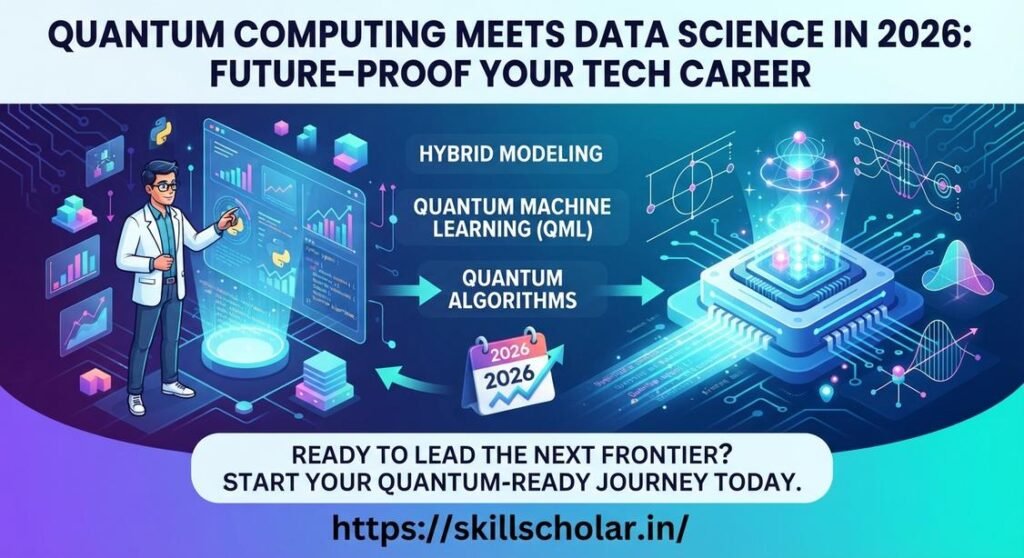
Quantum Computing Meets Data Science in 2026: Why This Is the Career Moment You Can’t Ignore
Estimated reading time: 8 minutes
Key Takeaways
- Quantum computing and data science are converging into quantum machine learning, creating a new frontier of high-demand tech skills for 2026 and beyond.
- A quantum-ready skill set blends classical data science foundations with quantum algorithm fundamentals, quantum ML, post-quantum cryptography, hybrid modeling, and quantum programming frameworks like Qiskit, Cirq, and PennyLane.
- Industries including pharmaceuticals, finance, logistics, and cybersecurity are expected to accelerate adoption of hybrid quantum-classical workflows by 2026.
- A practical career roadmap includes strengthening classical foundations, learning quantum fundamentals, specializing in quantum ML, building a portfolio, and staying current through continuous quantum computing upskilling programs.
- Tech career future-proofing through quantum-adjacent skills positions professionals to lead the paradigm shift rather than just survive it.
Table of Contents
- Why Quantum Computing and Data Science Are Converging
- The Rise of Quantum AI Training Programs
- The Skills That Define a Quantum-Ready Data Scientist
- Your Data Science Career Roadmap for 2026
- Why Quantum-Ready Skills Are the Ultimate Career Hedge
- Take the Leap with Skill Scholar
The technology world is standing at the edge of a paradigm shift. For decades, classical computers have powered everything from spreadsheets to sophisticated machine learning models. But as data volumes explode and problems grow more complex, the limits of classical computation are becoming impossible to ignore. Enter quantum computing — a field that is no longer a distant scientific curiosity, but a rapidly maturing industry set to reshape data science careers by 2026 and beyond.
At Skill Scholar, we help ambitious professionals master the technologies defining the next decade. The convergence of quantum computing and data science isn’t just a trend — it’s the next frontier of high-demand tech skills, and preparing now is how you stay ahead.
Why Quantum Computing and Data Science Are Converging
Data science thrives on pattern recognition, optimization, and probabilistic modeling. Quantum computing offers a fundamentally different way to process information using qubits, superposition, and entanglement. When these two fields meet, the result is quantum machine learning — algorithms that can potentially solve problems classical computers can’t, from molecular simulation to ultra-fast optimization.
By 2026, industries such as pharmaceuticals, finance, logistics, and cybersecurity are expected to accelerate adoption of hybrid quantum-classical workflows. Data scientists who understand quantum algorithm fundamentals will be positioned to lead these initiatives — not just support them.
The Rise of Quantum AI Training Programs
One of the most exciting developments is the convergence of quantum computing and generative AI. Quantum-enhanced AI could dramatically improve model training speeds, reduce computational costs, and unlock new forms of generative modeling. This is why quantum AI training programs are becoming a strategic priority for forward-thinking organizations and professionals alike.
The Skills That Define a Quantum-Ready Data Scientist
You don’t need a PhD in physics to enter this space. A quantum-ready skill set blends foundational data science knowledge with quantum literacy. Key areas include:
- Quantum algorithm fundamentals — understanding Grover’s, Shor’s, and variational algorithms
- Quantum machine learning — applying quantum circuits to classification and regression tasks
- Post-quantum cryptography skills — essential as quantum threats reshape cybersecurity
- Hybrid modeling — combining classical ML pipelines with quantum subroutines
- Quantum programming frameworks — Qiskit, Cirq, and PennyLane
These competencies are already appearing in job descriptions for forward-looking data science roles. Mastering them now means stepping into 2026 with a decisive advantage.
Your Data Science Career Roadmap for 2026
Building a quantum-ready career doesn’t happen overnight. Here’s a practical roadmap:
1. Strengthen Your Classical Foundation
Linear algebra, probability, and Python proficiency remain essential. Quantum computing builds on these, not replaces them.
2. Learn Quantum Fundamentals
Enroll in structured quantum computing certification programs that cover qubits, gates, and circuit design. Skill Scholar’s curriculum is built to take you from theory to applied practice.
3. Specialize in Quantum Machine Learning
Explore how quantum kernels, variational circuits, and quantum neural networks are applied in real-world data science problems.
4. Build a Portfolio
Work on hands-on projects — quantum optimization, hybrid modeling, and post-quantum cryptography simulations — that demonstrate practical capability to employers.
5. Stay Current with Emerging Tech Careers in 2026
The quantum job market is evolving quickly. Continuous upskilling through quantum computing upskilling programs keeps you relevant as the landscape shifts.
Why Quantum-Ready Skills Are the Ultimate Career Hedge
Tech career future-proofing has never been more important. Automation and AI are transforming traditional roles, but quantum-adjacent skills sit at the top of the high-demand tech skills list for 2026. Professionals who invest early in quantum computing upskilling will find themselves not just surviving the shift — but leading it.
The future of data science careers lies in the intersection of classical intelligence and quantum power. Those who act now will define the next generation of innovation.
Take the Leap with Skill Scholar
At Skill Scholar, we’re committed to equipping professionals with the exact skills employers will demand in 2026 and beyond. Our quantum computing certification tracks, quantum AI training programs, and data science career roadmap resources are designed for real-world impact.
The paradigm shift is coming. The only question is — will you be ready for it? Start your quantum-ready journey with Skill Scholar today.