
The Data Engineering Landscape in 2026: Why Generative AI Changes Everything
Estimated reading time: 9 minutes
Key Takeaways
- Generative AI for data engineering is transforming how pipelines are built, maintained, and optimized — moving from manual coding to intelligent automation.
- Intelligent data pipelines in 2026 are built on four pillars: AI-assisted ingestion, semantic transformation, vector databases with RAG, and automated orchestration.
- High-demand data engineering roles now require fluency in LLMs, vector stores, and prompt-driven workflows alongside classical fundamentals.
- Data engineering upskilling through hands-on training and internships is the fastest path to career resilience in the AI data era.
- Organizations that embrace automated ETL workflows and AI-driven data quality will ship faster, reduce downtime, and unlock insights buried under technical debt.
Table of Contents
- The Data Engineering Landscape in 2026: Why Generative AI Changes Everything
- What Does “Generative AI for Data Engineering” Actually Mean?
- Building Intelligent Data Pipelines in 2026
- High-Demand Data Engineering Roles in 2026
- How to Prepare: Upskilling for the AI Data Era
- Why Skill Scholar
- The Bottom Line
Data engineering has always sat at the intersection of infrastructure, code, and business logic. But by 2026, the discipline is undergoing its most dramatic transformation yet — thanks to Generative AI for data engineering. What used to require hours of hand-written SQL, brittle cron jobs, and manual schema mapping is now increasingly handled by intelligent systems that reason, generate, and self-heal.
For professionals and companies alike, this shift isn’t just a trend. It’s a redefinition of what it means to build and maintain a modern data stack. Organizations that embrace AI-powered data engineering will ship pipelines faster, reduce downtime, and unlock insights that were previously buried under technical debt. Those that don’t risk falling behind in an increasingly data-driven economy.
At Skill Scholar, we’ve watched this transition accelerate firsthand. Our mission is to equip the next generation of data professionals with the skills that hiring managers actually demand — and in 2026, that means fluency in generative AI workflows, not just traditional ETL.
What Does “Generative AI for Data Engineering” Actually Mean?
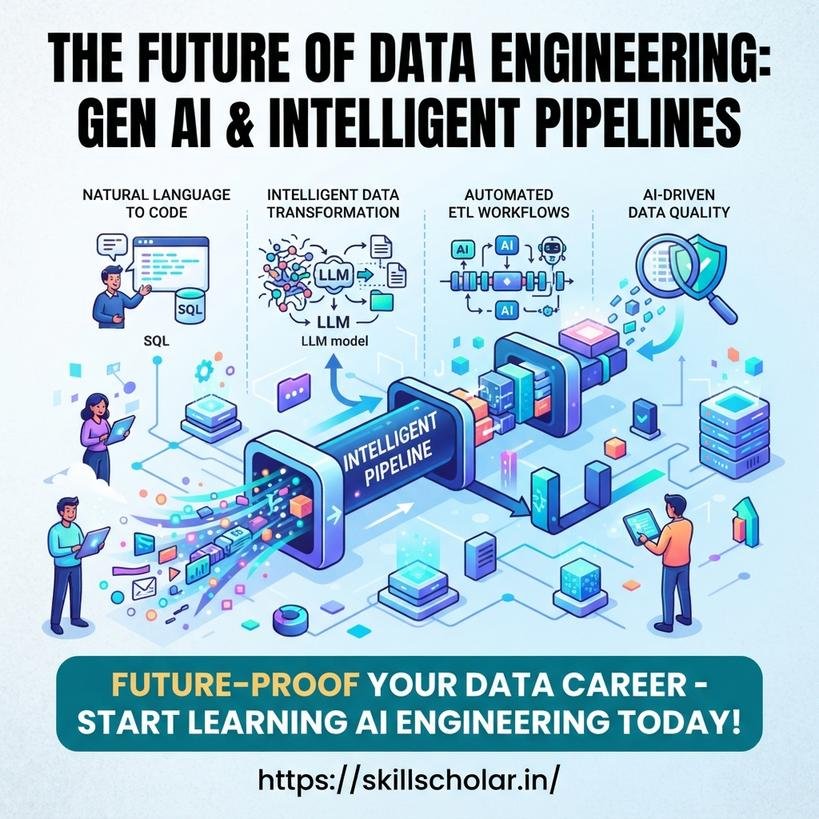
Generative AI refers to models — particularly large language models (LLMs) — that can produce structured outputs from natural language prompts. In the context of data engineering, this translates into several powerful capabilities:
1. Natural Language to SQL and Pipeline Code
Instead of writing complex joins or DAG definitions from scratch, engineers can now describe intent in plain English and let an LLM generate optimized code. This dramatically shortens development cycles and lowers the barrier to entry for analysts and junior engineers.
2. Intelligent Data Transformation
Using LLM for data transformation, pipelines can now clean, standardize, and enrich data with context-aware logic. Address parsing, sentiment tagging, entity recognition, and semantic deduplication can all be automated with models that understand meaning, not just patterns.
3. Automated ETL Workflows
Modern automated ETL workflows use AI agents to monitor pipeline health, detect anomalies, and even rewrite failing transformations in real time. This is a massive leap beyond traditional orchestration tools like Airflow alone.
4. AI-Driven Data Quality
Data quality has always been the silent killer of analytics projects. With AI-driven data quality, models continuously profile datasets, flag outliers, and suggest fixes — often before downstream consumers notice anything is wrong.
Building Intelligent Data Pipelines in 2026
So what does an intelligent data pipeline 2026-style architecture actually look like? It’s built on four pillars:
Pillar 1: AI-Assisted Ingestion
Ingestion layers now use AI to auto-detect schemas, infer data types, and adapt to source changes. New columns or renamed fields no longer break the pipeline — the system adjusts automatically.
Pillar 2: Semantic Transformation Layer
This is where generative AI shines. Models transform raw text, logs, and unstructured data into clean, queryable formats. Vector embeddings are generated for semantic search, and metadata is enriched for downstream governance.
Pillar 3: Vector Databases and RAG Pipelines
As companies build AI applications on top of their data, vector databases and RAG pipelines (Retrieval-Augmented Generation) become essential. Data engineers must now know how to chunk documents, generate embeddings, and wire retrieval systems into production LLM applications.
Pillar 4: Automated Orchestration and Observability
AI agents orchestrate tasks, retry failures with alternative logic, and provide natural language explanations of pipeline incidents. AI data orchestration skills are quickly becoming a core competency for senior engineers.
High-Demand Data Engineering Roles in 2026
The job market has already responded. Roles that barely existed three years ago are now among the most sought-after in tech:
- AI Data Engineer — builds pipelines that feed and are powered by LLMs
- RAG Pipeline Architect — designs retrieval systems for enterprise AI
- Data Platform Engineer (AI-Native) — manages the modern data stack with AI integrations
- ML DataOps Specialist — bridges MLOps and traditional data engineering
- Prompt & Pipeline Engineer — translates business logic into generative workflows
These high-demand data engineering roles 2026 share a common thread: they require both classical data engineering fundamentals and a working command of generative AI tooling.
How to Prepare: Upskilling for the AI Data Era
If you’re a data engineer, analyst, or student looking to future-proof your career, the path forward is clear — but it requires intentional data engineering upskilling.
Step 1: Master the Fundamentals
SQL, Python, distributed systems (Spark, Snowflake, BigQuery), and orchestration (Airflow, Dagster) remain non-negotiable. AI doesn’t replace these — it amplifies them.
Step 2: Learn Generative AI Integration
Understand how to call LLM APIs, structure prompts for pipeline tasks, and evaluate output quality. Familiarity with frameworks like LangChain and vector stores like Pinecone or Weaviate is a major advantage.
Step 3: Build Real Projects
Theory only goes so far. You need to build AI-powered ETL workflows, deploy RAG pipelines, and demonstrate measurable improvements in data quality or speed.
Step 4: Get Hands-On Experience
This is where Skill Scholar plays a role. Our modern data stack training programs are designed around real-world scenarios. Through a data engineering internship online, learners work on live pipelines, integrate generative AI tools, and build a portfolio that speaks directly to 2026 hiring managers.
Why Skill Scholar
At Skill Scholar, we don’t teach outdated workflows. Our curriculum is built around the tools, patterns, and AI integrations that companies are hiring for right now. Whether you’re breaking into data engineering or leveling up as a senior professional, our training bridges the gap between theory and production-ready skill.
The future of data engineering isn’t about writing more code — it’s about building smarter systems. With Generative AI in the driver’s seat, the engineers who thrive will be those who learn to direct, evaluate, and optimize intelligent pipelines.
The Bottom Line
By 2026, Generative AI for data engineering will no longer be a differentiator — it will be the baseline. Automated ETL workflows, intelligent data pipelines, and vector-based RAG systems are reshaping how companies manage data and how engineers build careers.
The question isn’t whether AI will transform data engineering. It’s whether you’ll be ready when it does. Start building the skills today with Skill Scholar — and position yourself at the center of the most in-demand discipline in tech.