
The 2026 Imperative: Why Centralized AI Is No Longer Enough
Estimated reading time: 8 minutes
Key Takeaways
- Federated learning enables model training on decentralized data without moving sensitive information to a central server.
- Privacy-preserving AI combines differential privacy, homomorphic encryption, secure multi-party computation, and trusted execution environments.
- Career opportunities in federated learning and privacy-first AI are exploding across healthcare, finance, and IoT.
- Skill Scholar offers specialized programs with hands-on labs, internship opportunities, and career support.
- Organizations that adopt decentralized machine learning now will lead their industries in trust, compliance, and innovation.
Table of Contents
- The 2026 Imperative: Why Centralized AI Is No Longer Enough
- What Is Federated Learning and Why Does It Matter in 2026?
- Key Benefits Driving Adoption
- Privacy-Preserving AI: Beyond Federated Learning
- Career Opportunities: Federated Learning and Privacy-First AI Roles
- Why Upskilling Now Is Critical
- How Skill Scholar Helps You Master Federated Learning & Privacy-Preserving AI
- Who Should Enroll?
- Real-World Applications: From Healthcare to Smart Cities
- The Future Is Federated: Preparing for 2026 and Beyond
In 2026, the AI landscape has reached an inflection point. Organizations across healthcare, finance, and IoT are drowning in data, yet they face an unprecedented challenge: how to train powerful machine learning models without centralizing sensitive information. Regulations like GDPR, HIPAA, and emerging AI governance frameworks have made it clear that data sovereignty and privacy are not optional. Enter federated learning and privacy-preserving AI—the technologies redefining how we build trustworthy machine learning systems.
At Skill Scholar, we specialize in equipping data and digital professionals with the skills to lead this transformation. This article explores the core concepts, career opportunities, and practical steps to upskill in this high-demand field.
What Is Federated Learning and Why Does It Matter in 2026?
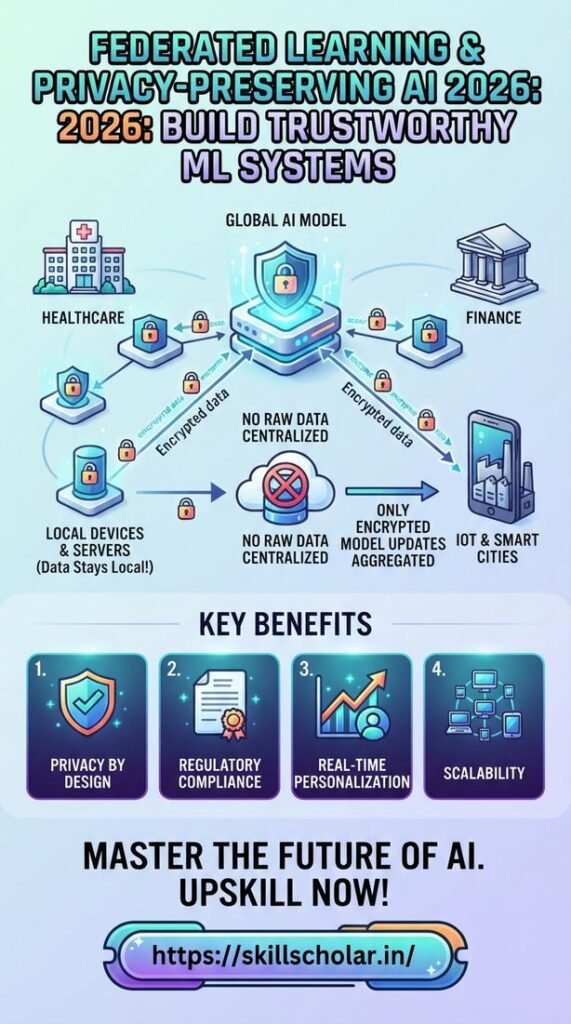
Federated learning is a decentralized machine learning approach that trains algorithms on data residing on edge devices or local servers—without moving that data to a central location. Instead of sending raw data to the cloud, models are trained locally, and only encrypted model updates are aggregated. This preserves privacy, reduces latency, and complies with data residency laws.
By 2026, federated learning vs centralized ML is no longer a theoretical debate. Centralized ML struggles with data silos, regulatory hurdles, and costly data transfers. Federated learning solves these by enabling on-device collaborative learning across hospitals, banks, or smart factories.
Key Benefits Driving Adoption
- Privacy by design: Sensitive data never leaves its source.
- Regulatory compliance: Aligns with data privacy compliance AI 2026 requirements.
- Real-time personalization: Models improve locally without centralized data collection.
- Scalability: Leverages millions of edge devices for collaborative training.
Privacy-Preserving AI: Beyond Federated Learning
Federated learning is a cornerstone, but it’s not the only technique. Privacy-preserving AI training encompasses a suite of methods:
- Differential privacy: Adds noise to data or model updates to protect individual records.
- Homomorphic encryption: Allows computation on encrypted data, enabling secure aggregation.
- Secure multi-party computation: Multiple parties jointly compute a function without revealing inputs.
- Trusted execution environments: Hardware-based isolation for sensitive computations.
Combining these with federated learning creates robust trustworthy AI training online pipelines. For example, a healthcare AI system can use federated learning across hospitals, differential privacy to mask patient details, and homomorphic encryption to secure model updates.
Career Opportunities: Federated Learning and Privacy-First AI Roles
The demand for professionals skilled in federated learning career 2026 is skyrocketing. Companies are hiring for roles like:
- Federated Learning Engineer
- Privacy-Preserving ML Scientist
- AI Governance Specialist
- Decentralized AI Architect
- Privacy-Preserving Analytics Consultant
These roles require a blend of machine learning, distributed systems, cryptography, and compliance knowledge. According to industry reports, high-demand AI skills 2026 include federated learning frameworks (TensorFlow Federated, PySyft), differential privacy libraries (Opacus, TensorFlow Privacy), and homomorphic encryption toolkits (Microsoft SEAL, IBM HElib).
Why Upskilling Now Is Critical
The shift toward decentralized machine learning is not a fad—it’s a structural change. As AI governance and data sovereignty regulations tighten, organizations need experts who can build systems that are both intelligent and compliant. Privacy-first AI career paths offer job security, competitive salaries, and the chance to work on cutting-edge problems.
How Skill Scholar Helps You Master Federated Learning & Privacy-Preserving AI
Skill Scholar offers specialized programs designed for data and digital professionals looking to transition into this high-growth field. Our curriculum covers:
- Federated learning fundamentals: From centralized to decentralized architectures.
- Privacy-preserving techniques: Differential privacy, homomorphic encryption, and secure aggregation.
- Hands-on projects: Build real-world federated learning systems for healthcare, finance, and IoT.
- AI governance and data sovereignty: Understand global regulations and ethical AI frameworks.
- Career support: Resume building, interview prep, and access to our hiring partner network.
We also offer a federated learning internship online for those seeking practical experience. Our secure AI training programs are taught by industry practitioners who have deployed privacy-preserving AI at scale.
Who Should Enroll?
- Data scientists and ML engineers wanting to specialize in privacy-preserving AI.
- Software developers moving into decentralized systems.
- Compliance and governance professionals needing technical AI knowledge.
- Students and career-changers seeking trustworthy AI training online.
Real-World Applications: From Healthcare to Smart Cities
Healthcare AI privacy training is one of the most in-demand areas. Federated learning allows hospitals to train diagnostic models without sharing patient data, complying with HIPAA and GDPR. In finance, banks use it for fraud detection across institutions without revealing transaction details. Smart cities leverage on-device collaborative learning for traffic prediction while preserving citizen privacy.
These applications demonstrate why privacy-preserving analytics skills are essential. Organizations that master them will lead their industries; those that don’t risk fines, breaches, and lost trust.
The Future Is Federated: Preparing for 2026 and Beyond
As we move deeper into 2026, the convergence of AI, privacy, and regulation will only accelerate. Federated learning and privacy-preserving AI are no longer niche—they are the foundation of trustworthy, compliant, and scalable machine learning. Whether you’re an individual professional or an enterprise team, investing in these skills today ensures you’re ready for tomorrow.
Skill Scholar is your partner in this journey. Our expert-led courses, hands-on labs, and career services are designed to transform you into a leader in decentralized machine learning and AI governance. Explore our programs and take the first step toward a future-proof career.
Ready to build trustworthy AI systems without centralizing sensitive data? Enroll in Skill Scholar’s Federated Learning & Privacy-Preserving AI specialization today.