
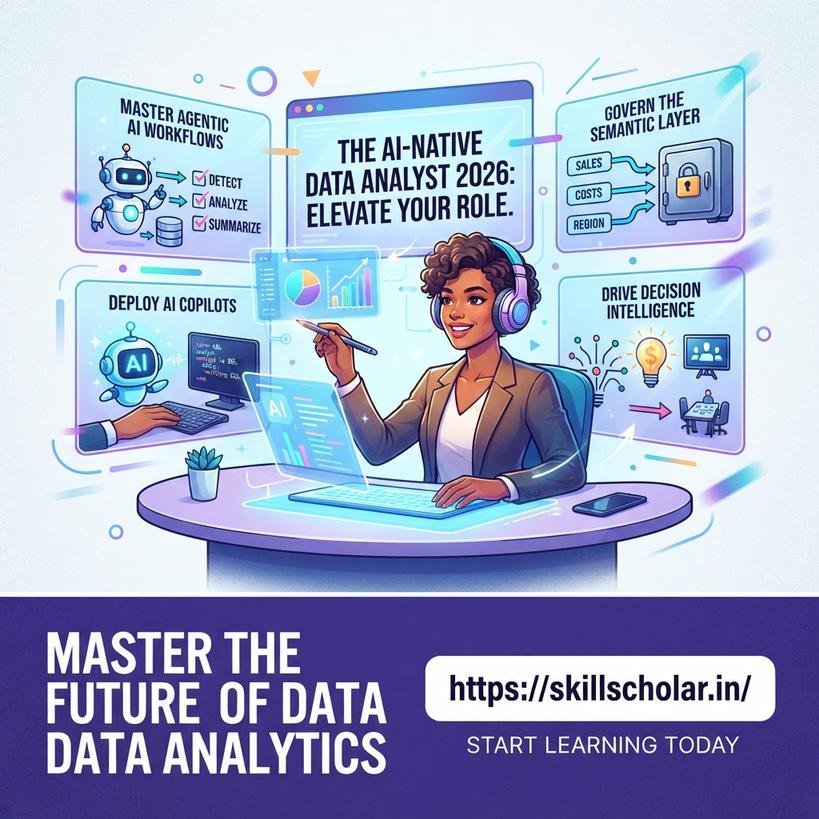
Why the AI-Native Data Analyst Is the Most In-Demand Role of 2026
Estimated Reading Time: 7 minutes
Key Takeaways
- AI-native data analysts are replacing traditional dashboard builders as companies prioritize agentic AI workflows and decision intelligence.
- Core competencies now include prompt engineering for analysts, semantic layer governance, and conversational analytics skills.
- Agentic AI for data analytics shifts the analyst role from producing insights to governing and validating machine-generated findings.
- Structured training with hands-on labs and a data analytics internship online provides the portfolio evidence employers demand.
- The future of data analyst roles 2026 is elevation, not extinction—judgment and governance command premium compensation.
Table of Contents
- Why the AI-Native Data Analyst Is the Most In-Demand Role of 2026
- What Makes an Analyst “AI-Native”?
- Agentic AI: Your Always-On Analytics Teammate
- Automated Insight Generation: From Dashboards to Narratives
- The Skills Stack for 2026 Analytics Roles
- How to Build These Skills in 2026
- The Bottom Line: Adapt Now or Fall Behind
The data analyst of 2020 built dashboards. The data analyst of 2026 orchestrates AI agents, interrogates data in natural language, and turns automated insights into executive decisions. This shift isn’t incremental—it’s a structural change in how analytics teams create value. Companies no longer hire analysts simply to pull numbers; they hire AI-native data analysts who can design agentic AI workflows, validate machine-generated insights, and lead decision intelligence initiatives.
At Skill Scholar, we’ve watched this transformation accelerate across every industry we serve. The analysts who thrive are those who treat AI as a collaborator rather than a threat. If you want a high-impact analytics role in 2026, here’s exactly what you need to master—and how to build those skills.
What Makes an Analyst “AI-Native”?
Being AI-native doesn’t mean knowing how to prompt ChatGPT. It means embedding AI into the entire analytics lifecycle—from data preparation to storytelling. An AI-native analyst:
- Uses AI copilots for data analysts to write SQL, clean datasets, and draft initial analyses
- Deploys agentic AI for data analytics to autonomously monitor metrics and surface anomalies
- Builds AI-powered dashboard automation so stakeholders get answers without waiting for tickets
- Applies prompt engineering for analysts to get reliable, reproducible results from LLMs
- Grounds every AI output in a governed semantic layer and AI analytics architecture
These capabilities are already appearing in job descriptions under titles like “Analytics Engineer,” “Decision Intelligence Analyst,” and “AI-Augmented Business Analyst.” The common thread: AI fluency is now a core competency, not a bonus.
Agentic AI: Your Always-On Analytics Teammate
Agentic AI represents the biggest leap. Unlike passive copilots that wait for prompts, agents can plan multi-step tasks, call tools, and escalate findings. In analytics, that means an agent can monitor revenue dashboards overnight, detect a 12% drop in a regional segment, run root-cause queries across three tables, and deliver a Slack summary before your morning stand-up.
For analysts, this changes the job from producing insights to governing them. You define the guardrails, validate the logic, and translate findings into business action. That’s the essence of the decision intelligence career path—and it’s where salaries and influence are rising fastest.
Automated Insight Generation: From Dashboards to Narratives
Traditional BI required stakeholders to interpret charts. Automated insight generation flips the model: AI scans the data, identifies statistically significant changes, and writes plain-language explanations. Tools now surface statements like “Customer acquisition cost rose 18% in EMEA, driven by paid social spend,” complete with supporting evidence.
But automation without judgment is dangerous. AI-native analysts learn to audit these narratives, catch spurious correlations, and add context that models miss. This is why data storytelling with AI is a rising skill: the analyst becomes the editor-in-chief of machine-generated insights.
The Skills Stack for 2026 Analytics Roles
Based on the hiring patterns we see through Skill Scholar’s employer network, here are the competencies that separate candidates:
1. Conversational Analytics Skills
Natural language data querying is becoming table stakes. Analysts must know how to phrase questions so LLMs return accurate SQL, how to validate generated queries, and how to design conversational interfaces for business users. This blends linguistics, data modeling, and skepticism.
2. Semantic Layer Fluency
AI is only as good as the definitions it queries. Understanding how a semantic layer and AI analytics work together—metrics governance, entity relationships, business logic—is now essential. Analysts who can maintain clean semantic models will be the gatekeepers of trustworthy AI output.
3. Prompt Engineering for Analysts
Prompt engineering for analysts isn’t about clever tricks; it’s about reproducibility. You’ll need to design prompt templates for recurring tasks, test them against edge cases, and document them for your team. This is a learnable skill—and one of the fastest ways to stand out.
4. AI-Augmented Analytics Workflow Design
The modern AI-augmented analytics workflow looks like this: agent monitors → copilot drafts analysis → analyst validates → AI generates narrative → stakeholder decides. Mastering this pipeline—and knowing where to insert human checkpoints—is the core of the role.
How to Build These Skills in 2026
The gap between traditional and AI-native analysts is closing fast, but only for those who upskill deliberately. Self-teaching through scattered tutorials won’t cut it; employers want evidence of applied capability.
Skill Scholar’s generative AI data analytics training is built around this exact gap. Our data analyst AI upskilling 2026 track combines:
- Hands-on labs with agentic AI tools and copilot platforms
- Real datasets where you design automated insight pipelines end-to-end
- Prompt engineering exercises graded against production standards
- A data analytics internship online component so you graduate with portfolio evidence, not just certificates
Participants leave with the high-demand analytics skills 2026 employers are actively recruiting for—and a clear narrative for interviews about how they’ve used AI to drive decisions.
The Bottom Line: Adapt Now or Fall Behind
The future of data analyst roles 2026 is not extinction—it’s elevation. Routine reporting will be automated. Judgment, governance, and decision intelligence will be premium. Analysts who embrace AI-native data analyst 2026 practices will find themselves advising executives, designing AI systems, and commanding higher compensation.
The tools will keep changing; the mindset won’t. Start by integrating one AI copilot into your daily workflow this week. Then build outward—agentic monitoring, automated narratives, semantic governance. And if you want a structured path with employer-recognized validation, explore Skill Scholar’s data analytics program and position yourself at the front of the 2026 hiring wave.